 how-to
How to Fix Golf Cart Steering: 2026 Repair Guide
Table of Contents
- Safety First: Your Pre-Repair Checklist
- Diagnosing Loose Golf Cart Steering and Front End Play
- Troubleshooting Loose Golf Cart Steering: Common Causes and Fixes
- Golf Cart Steering Gearbox Adjustment: Step-by-Step
- Golf Cart Steering Alignment: Toe-In, Toe-Out, and Steering Wheel Centering
- Lubrication, Torque Specs, and Long-Term Maintenance
- When to Replace vs. Repair Steering Components
- Frequently Asked Questions
Last Updated: September 25, 2026
Safety First: Your Pre-Repair Checklist
Here is the full checklist:
- Park on flat, hard ground, never a slope
- Engage the parking brake and remove the key
- Chock both rear wheels with solid blocks
- Disconnect the main battery pack if you will be working near wiring
- Wear safety glasses and gloves
- Jack the front end only if you need to inspect from below, and support it with jack stands, never the jack alone
- Take photos before you loosen anything
Before you start, note how the steering feels now at low and full speed. That baseline tells you whether your fix worked.
Diagnosing Loose Golf Cart Steering and Front End Play
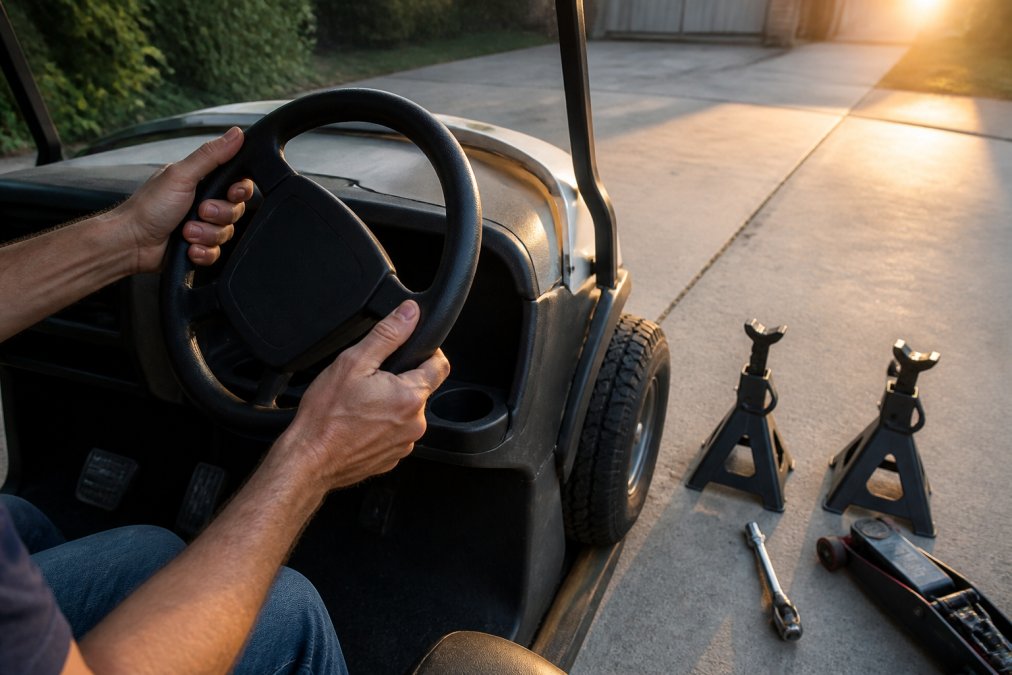
Diagnosing loose golf cart steering starts with a simple test: with the cart parked and wheels straight, turn the wheel gently and watch how far it moves before the front wheels respond. That gap is your steering play, and it points to the worn part.
How to Identify Steering Play and Mechanical Slack
Steering play is the free movement in the wheel before the front wheels turn. A little is normal; too much means something in the linkage has worn.
A common approach is the two-person test:
- Have a helper sit in the driver's seat and turn the wheel slowly back and forth through the sloppy zone.
- Lie beside the front axle and watch each joint as the wheel moves.
- Look for a joint that moves on one side but not the other. That lag is your culprit.
Inspecting Tie Rod Ends, Ball Joints, and Bushing Wear
Tie rod ends connect the steering linkage to the steering knuckle. Twist or rock each one by hand; any clunk or looseness means it needs replacing.
Troubleshooting Loose Golf Cart Steering: Common Causes and Fixes
Troubleshooting loose golf cart steering comes down to finding which part has worn out, and the decision that matters: is it adjustable, or is it done?
| Symptom | Likely Cause | Fix | Adjustable or Replace? |
|---|---|---|---|
| Wheel turns far before wheels move | Worn tie rod ends | Replace tie rod ends, then align | Replace |
| Clunk over bumps | Worn ball joints | Replace ball joints | Replace |
| Vague, wandering feel | Worn bushings or loose gear box | Replace bushings, adjust gear box | Adjust first, replace if no change |
| Wheel off-center when driving straight | Steering wheel centering off | Re-center wheel and align | Adjust |
| Shimmy or vibration at speed | Worn front end suspension parts | Inspect and replace worn parts | Replace |
| Steering wheel has play but joints are tight | Gear box mesh too loose | Adjust the gear box | Adjust |
The Go/No-Go Safety Check Before You Turn a Wrench
Before repairing anything, run this pass/fail check. If the cart fails any line, stop and have it inspected by a qualified technician, do not test drive it.
- Grab test: With the front end raised on jack stands, grab each front tire at 12 and 6 o'clock and rock it. Any clunk or visible movement at the ball joint is a fail.
- Tie rod twist test: Twist each tie rod end by hand. Free rotation with no resistance, or visible in-and-out slop, is a fail.
- Cotter pin check: Every castle nut on the steering linkage must have a cotter pin that is intact and properly spread. A missing or sheared pin is a fail.
- Steering play measurement: With the wheels straight and the cart on the ground, measure free play at the rim of the steering wheel. More than about 1 inch before the front wheels respond is excessive; more than 2 inches is a fail.
- Dry joint check: Any grease fitting that will not take grease, or any joint that shows rust-colored dust weeping out, is a fail.
When Adjustment Is the Right Call
Adjustment is the right fix when the parts are sound but the mesh or geometry has drifted:
- The gear box has play but no grinding or notchiness.
- The tie rod ends are tight but the toe setting is off.
- The steering wheel is off-center but the front end tracks straight.
- Fasteners are loose but the castings and joints show no wear.
When Replacement Is the Only Safe Option
Replace, do not adjust, when:
- A tie rod end or ball joint has any visible play.
- A bushing is cracked, torn, squished, or missing.
- A cotter pin is sheared, or a joint has clearly been run dry.
- The rack and pinion on a newer cart has internal wear, adjustment will not recover a worn rack.
- The gear box binds or notches through part of its range even after a correct adjustment.
Some of these you can fix in an afternoon; others, like a badly worn rack and pinion, are better handled by a shop.
Golf Cart Steering Gearbox Adjustment: Step-by-Step
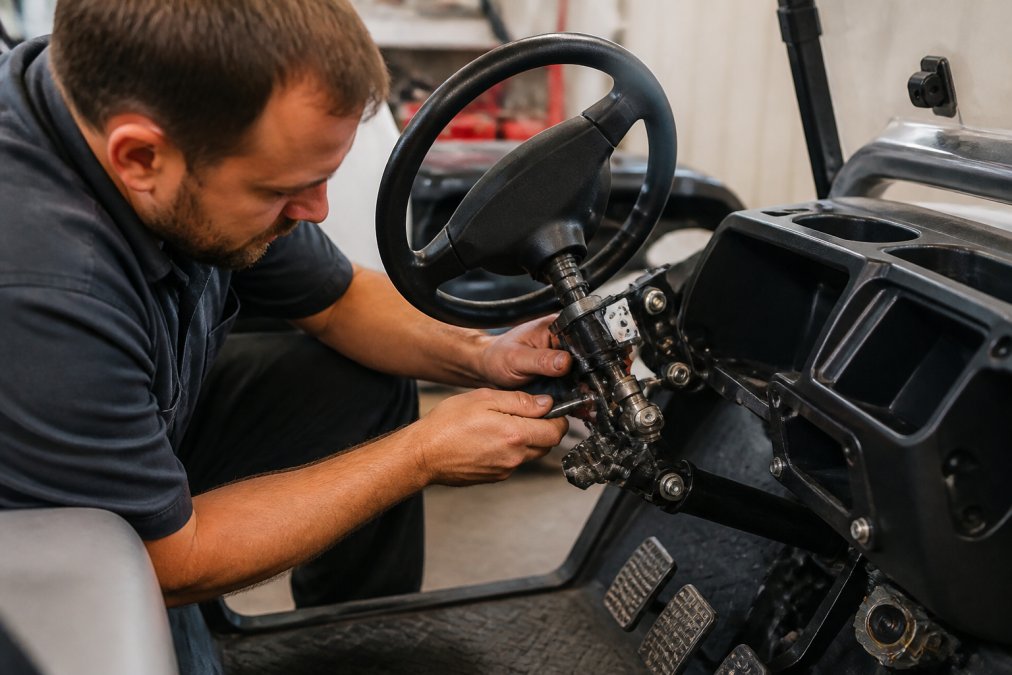
Golf cart steering gearbox adjustment tightens the mesh between the gears inside the box, removing slack without replacing parts, the fix for a wheel that feels loose but has no obviously worn joints.
Total time: 30 to 45 minutes Difficulty: Intermediate
What You'll Need
- Socket set and open-end wrenches
- Flathead screwdriver
- Torque wrench
- Jack and jack stands
- Shop manual or torque spec sheet for your model
Step 1: Locate the Gear Box [Time: 5 minutes]
Find the steering gear box where the steering shaft meets the front axle. On most carts it sits low, near the center of the front end.
Step 2: Loosen the Jam Nut [Time: 5 minutes]
The adjustment screw sits on top of the gear box, locked by a jam nut. Loosen the jam nut with an open-end wrench while holding the screw steady.
Step 3: Turn the Adjustment Screw [Time: 10 minutes]
Turn the screw clockwise an eighth of a turn at a time, checking the steering wheel for play after each turn.
Expected Result: The free play shrinks with each small turn. Stop when the wheel feels firm but still turns smoothly with no binding.
Step 4: Lock the Jam Nut [Time: 5 minutes]
Hold the screw in place and tighten the jam nut against the gear box. This locks your setting.
Step 5: Test Drive [Time: 10 minutes]
Lower the cart and drive slowly. The steering should feel tighter and return to center on its own.
Over-tightening the adjustment screw is the most common DIY mistake. Too tight and the gears bind, which wears them out fast and can make the cart hard to steer. If the wheel feels stiff, back the screw off a quarter turn.
Tightening the Jam Nut and Setting Fastener Tension
The jam nut holds your adjustment in place, so it has to be tight. A loose one lets the screw drift, and your steering goes sloppy again within a few drives.
Golf Cart Steering Alignment: Toe-In, Toe-Out, and Steering Wheel Centering
Golf cart steering alignment sets the front wheels so they point correctly relative to each other. Toe-in means the fronts point slightly toward each other; toe-out means they point apart. Get it wrong and the cart pulls or eats tires.
Here is the basic process:
- Park on level ground with the wheels straight ahead.
- Measure the distance between the front edges of both front tires.
- Measure the distance between the rear edges of the same tires.
- Compare the two numbers. The difference is your toe setting.
- Adjust the tie rod ends to bring the setting into spec.
- Re-center the steering wheel by adjusting each tie rod equally.
Lubrication, Torque Specs, and Long-Term Maintenance
Lubrication and correct fastener tension keep your steering tight for the long haul. Most steering problems we see started with a dry joint or a loose bolt nobody checked, not a broken part.
Lubrication: What to Grease and How Often
Grease every fitting on the steering linkage at each service, tie rod ends and ball joints often have one, and a dry joint wears out fast. A few rules:
- Wipe the fitting clean before you attach the grease gun. Pushing grit into a joint is worse than leaving it dry.
- Pump until you see fresh grease weep from the boot or the joint's relief. Stop there, over-greasing can split a boot.
- If a fitting will not take grease, do not force it. The passage is blocked. Replace the fitting or the joint.
- Use a lithium-complex or moly-fortified chassis grease unless your shop manual specifies otherwise.
Torque Specs: Why You Cannot Guess
Torque specs are model-specific and vary enough between makers that a forum number can strip a casting or leave a fastener loose. Pull the spec from your model's shop manual or the manufacturer's service documentation before tightening anything on the steering linkage.
- Castle nuts on tie rod ends and ball joints are torqued to seat the tapered stud, then advanced only as far as needed to line up the cotter pin hole. Never back a castle nut off to reach the hole, go tighter to the next slot.
- Jam nuts on the gear box adjustment screw are the fastener most often left under-tightened. A loose jam nut lets the adjustment screw drift, and your steering goes sloppy again within a few drives.
- Steering wheel retaining nut is a high-torque fastener on most carts. Under-tightening it lets the wheel work loose on the shaft.
- Suspension and knuckle fasteners are typically the highest-torque bolts in the front end. Re-check them after the first few drives following any front end work.
Write your cart's torque specs on a card and tape it inside the seat compartment or under the dash. You will reach for it every time you service the front end, and you will not have to dig out the manual.
A Maintenance Schedule That Actually Prevents Loose Steering
- Monthly: Look for play in the steering wheel and listen for clunks over bumps.
- Every few months: Grease all fittings on the steering linkage.
- Twice a year: Check torque on tie rod ends, drag link, and gear box fasteners. Re-check the jam nut on the gear box adjustment screw.
- Annually: Full front end inspection, including bushings and ball joints. Replace any cotter pin that shows corrosion.
What Wears Out First, and Why
The wear order on a typical cart is predictable: tie rod ends first, then ball joints, then bushings, then the gear box internals. A cart with 500 hours and vague steering often has a tie rod end at the top of the list.
The single best habit for long steering life is a quick monthly check of steering play. Catching a loose joint early saves you from replacing the whole linkage later.
When to Replace vs. Repair Steering Components
Replace a steering component when it is worn past its service limit, and repair when the problem is adjustment or lubrication. The hard part is knowing which situation you are in.
Repair makes sense when:
- The gear box just needs adjustment
- Joints are dry and need grease
- Fasteners are loose but the parts are sound
- The steering wheel is simply off-center
Replace makes sense when:
- A tie rod end or ball joint has visible play
- Bushings are cracked, torn, or missing
- A cotter pin is sheared or a joint has been run dry
- The rack and pinion has internal wear
Frequently Asked Questions
My golf cart steering wheel isn't straight. How can I fix it?
A crooked steering wheel usually means the front wheels are out of alignment or the steering wheel was removed and reinstalled off-center. First, check tire pressure and inspect tie rod ends for wear. Then, with the wheels pointed straight ahead, loosen the steering wheel nut and reposition the wheel. If the wheel is centered but the cart still pulls, the issue is alignment, not the wheel itself. A proper golf cart steering alignment will correct toe-in or toe-out and restore straight tracking.
How do I know if my golf cart steering gearbox is bad?
Excessive steering play, grinding noises, or a steering wheel that feels loose or unresponsive often point to a worn gearbox. With the front wheels off the ground, turn the steering wheel gently and watch for delayed movement at the wheels. If you can turn the wheel several inches before the tires respond, the gearbox or steering linkage is the likely culprit. Check for grease leaks around the gearbox housing and inspect the steering shaft for wobble. A qualified technician can confirm whether adjustment or replacement is needed.
Why is my golf cart hard to steer?
Hard steering can come from low tire pressure, a dry or worn steering gearbox, seized tie rod ends, or a binding steering column. Start by checking tire pressure and lubricating all grease fittings on the steering linkage. If the problem persists, inspect the rack and pinion or gearbox for internal wear. On many carts, a worn steering knuckle or ball joint will also make turning difficult. Addressing these components early prevents more expensive front end suspension damage.
What are some common steering problems with EZGO golf carts?
EZGO carts commonly develop play in the steering gearbox, worn tie rod ends, and loose jam nuts on the drag link. Owners also report steering wheel drift and vibration through the steering column. Routine lubrication of the grease fittings and checking fastener tension at the steering knuckle helps prevent these issues. If you notice mechanical slack or unusual steering feedback, inspect the steering linkage and front axle components before the problem worsens.
Steering problems rarely fix themselves, and a loose front end only gets worse with every drive. Amplify Your Ride offers full golf cart service and repair, plus new and used cart sales, rentals, and parts. Our team can diagnose your steering, adjust the gear box, and align the front end correctly the first time. Get started with Amplify Your Ride and get your cart steering straight and safe again.