 How-to
7 Golf Cart Tire Maintenance Habits That Extend Tire Life
Last Updated: November 15, 2026
Quick Summary
Maintain golf cart tires with a monthly 8-point walk-around inspection that checks pressure with a gauge, tread wear, sidewalls, embedded objects, valve stems, wheel wobble, and lug nuts. Correct tire pressure is the single biggest factor in golf cart tire lifespan, so check it monthly and before long trips. Rotate tires per your owner's manual, fix slow leaks early, and replace any tire with sidewall cracks or bulges.
- A monthly walk-around inspection takes five minutes and catches small tire problems early.
- The owner's manual wins over the tire sidewall when the two pressure numbers disagree.
- Underinflation causes outer edge wear, higher rolling resistance, and longer stopping distances.
- Rotate closer to the 50-hour mark if you drive on pavement or carry heavy loads.
- Never plug a sidewall puncture or a tire with a bulge; replace it instead.
Table of Contents
- Start With a Monthly Golf Cart Tire Inspection
- Nail Your Golf Cart Tire Pressure
- How Low Pressure Hurts Handling, Range, and Golf Cart Tire Wear
- Golf Cart Tire Rotation: Timing and Patterns
- Find and Fix Slow Leaks Before They Strand You
- Tread Depth and Golf Cart Tire Lifespan: When to Replace
- Seasonal Care: Cold Weather, Storage, and Temperature Swings
- Book Your Tire Inspection and Service at Amplify Your Ride
- Frequently Asked Questions
Start With a Monthly Golf Cart Tire Inspection
A monthly walk-around inspection is a practical way to extend the life of your golf cart tires. It takes five minutes and catches small problems before they become expensive ones. Your tires are the only part of the cart touching the ground, so they deserve a regular look.
Golf cart tires wear differently than car tires. Carts are light, speeds are low, and many sit parked for long stretches. That combination hides problems well. A slow leak or a cracked sidewall can go unnoticed for weeks until the cart starts pulling or the tire goes flat mid-round.
Here is a routine that works for anyone learning how to maintain golf cart tires.
The 8-Point Walk-Around Checklist
Work through this list once a month, in the same order every time:
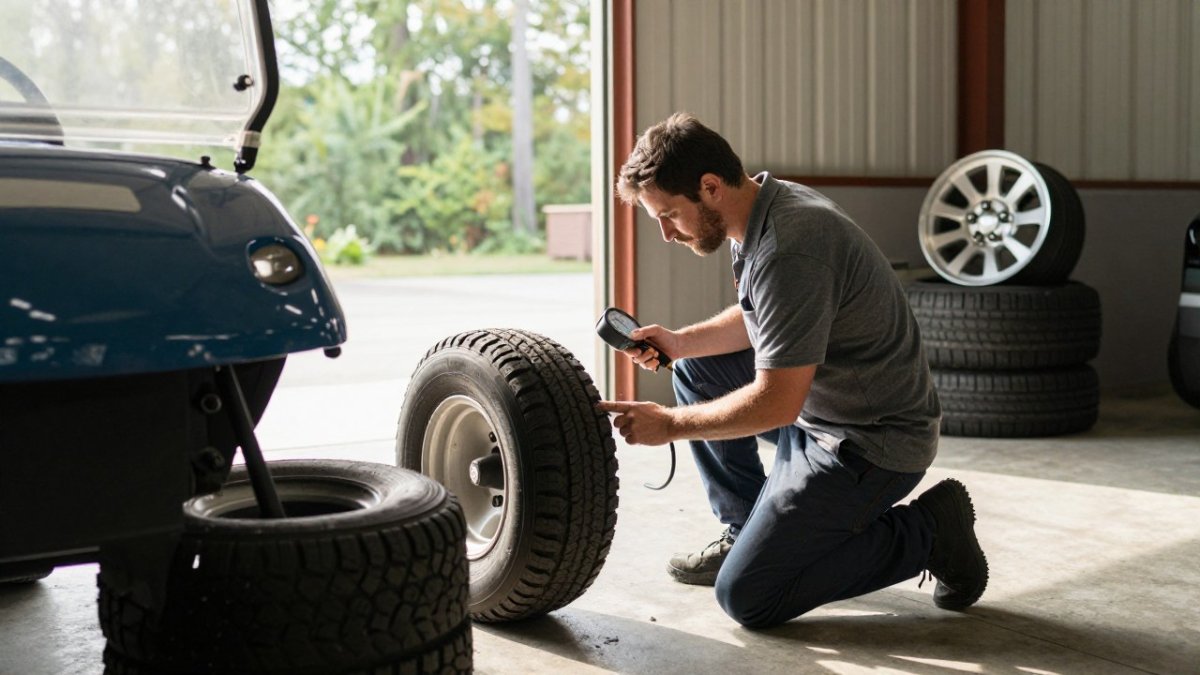
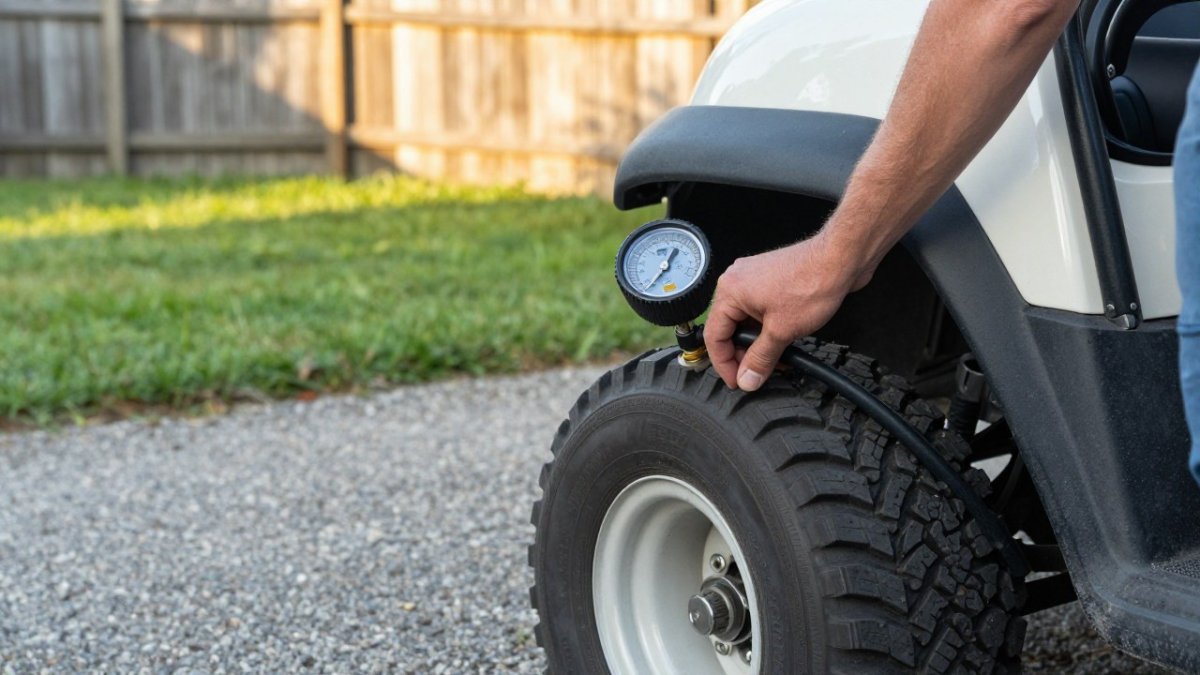
- Check each tire's pressure with a gauge, not a kick
- Look for tread wear, especially on the front tires
- Inspect sidewalls for cracks, bulges, or scuffs
- Feel for embedded nails, screws, or glass
- Check the valve stem caps and look for stem cracks
- Spin each wheel and listen for rubbing or wobble
- Confirm lug nuts are snug
- Note any tire that looks lower than the others
Write down the pressure readings each month. A tire that keeps dropping is telling you something.
The man is American.
If you want a full service schedule to pair with this tire routine, our golf cart maintenance checklist for owners lays out every check by month and season.
Nail Your Golf Cart Tire Pressure
Correct tire pressure is the single biggest factor in golf cart tire lifespan. Check it monthly and before any long trip. Pressure affects how the cart handles, how far the battery takes you, and how fast the tread wears down.
The right number lives in your owner's manual and on the tire sidewall. Those two sources disagree sometimes, and the manual wins for your specific cart. A common mistake is inflating to the number stamped on the tire, which is a maximum, not a target.
Use a quality tire gauge. Cheap pencil gauges drift, and a reading that is off by a few PSI is worse than no reading at all.
Pressure by Cart Model, Tire Size, and Load
There is no universal PSI for golf carts. Pressure depends on the cart's weight, the tire size, and what you're carrying. The table below gives typical starting ranges based on common setups.
| Setup | Typical Pressure Range (PSI) | Notes |
|---|---|---|
| Standard 8-inch tire, 2 passengers | 12-18 | Lower end for turf, higher for pavement |
| Standard 8-inch tire, 4 passengers or cargo | 18-22 | Add 2-4 PSI for sustained loads |
| 10-inch or larger aftermarket tire | 20-25 | Larger volume needs more air; check sidewall max |
| Off-road or turf tire | 10-15 | Follow tread design; too much pressure reduces grip |
Typical Pressure Range (PSI)
These ranges are typical for many carts, but they are not a substitute for your manual. When you add a rear seat kit, a lift, or heavy cargo, recheck pressure with the load on board.
To find the correct pressure for your specific cart, start with the manual's recommendation.
Watch out: never exceed the maximum pressure stamped on the tire sidewall, even if the manual lists a higher number. The sidewall max is a safety limit that applies regardless of vehicle recommendations.
How Low Pressure Hurts Handling, Range, and Golf Cart Tire Wear
Underinflated tires are a common problem on golf carts. Low pressure makes the tire squat, and a squatted tire flexes more with every rotation. That flex builds heat and chews through the tread edges.
The effects stack up fast:
- Handling: the cart wanders and feels mushy in turns
- Range: rolling resistance rises, so the battery drains sooner
- Wear: outer edges wear faster than the center
- Safety: a soft tire grips poorly and stops longer
Overinflation causes the opposite problem. The center of the tread wears first, and the ride gets harsh. Both extremes shorten golf cart tire lifespan.
If handling feels off even after you set pressure correctly, the cause may not be tires at all. Our guide to troubleshooting common golf cart brake issues covers the stopping and control problems that mimic tire trouble. Steering can also be the culprit, and our walkthrough on how to fix golf cart steering helps you tell the difference.
Golf Cart Tire Rotation: Timing and Patterns
Rotation intervals depend on use; check your owner's manual for the recommended schedule. If you drive on pavement often or carry heavy loads, rotate closer to the 50-hour mark. Rotation evens out wear so all four tires retire at the same time. On a cart, the rear tires usually wear faster because they carry the motor, the rear seat, and most of the load.
The pattern depends on your setup:
- Same size front and rear (non-directional): swap front to rear on the same side, then cross the rears to the front. This is the standard cross pattern and works for most carts.
- Larger rear tires (staggered): you cannot rotate front to rear, so swap left to right on the same axle instead. Mark them so you don't mix them up.
- Directional tread: keep each tire on its side and swap front to rear only. Directional tires must roll in the direction indicated by the arrow on the sidewall.
Mark each tire with chalk before you start so you can track the pattern. Check pressure after rotation and take a short test drive.
When Rotation Is Not Appropriate
Rotation is not always the right move. Skip it if any tire shows uneven wear that suggests an alignment problem, a bent axle, or a failing bearing. Rotating a badly worn tire to a different position can mask the underlying issue and make handling worse. Fix the cause first, then rotate.
Also avoid rotation if you have a mix of tire sizes or tread designs. Mixing a turf tire with a pavement tire on the same axle can cause handling problems, especially in wet conditions. If you must replace one tire, replace the pair on that axle to keep wear even.
How to Rotate Safely
Park on a flat, hard surface and set the parking brake. Loosen the lug nuts slightly before lifting the cart. Use a jack rated for the cart's weight and place jack stands under the frame, not the axle. Tighten lug nuts in a star pattern to the manufacturer's torque spec. Recheck torque after 25 miles of driving.
Watch out: never work under a cart supported only by a jack. Use jack stands every time, even for a quick rotation.
Find and Fix Slow Leaks Before They Strand You
A tire that loses a few PSI a week has a slow leak, and it will not fix itself. Find it before it becomes a flat in the middle of a golf course.
Here is a method for finding the leak:
- Inflate the tire to spec and note the pressure
- Wait a day and recheck; a drop confirms a leak
- Spray soapy water on the tread, sidewall, and valve stem
- Watch for bubbles; they mark the leak point
- Check the valve core, a common and cheap culprit
- Look for a nail head or screw in the tread
A leaking valve core often just needs tightening or replacing. A puncture in the tread can usually be plugged or patched. A crack or bulge in the sidewall cannot be repaired safely, and that tire needs replacing.
Watch out: never plug a sidewall puncture or a tire with a bulge. The sidewall flexes constantly, and a plug there can fail at speed with no warning.
Tread Depth and Golf Cart Tire Lifespan: When to Replace
Golf cart tire lifespan depends on terrain, load, pressure habits, and sun exposure. Replace a tire when any of these show up:
- Tread worn down to the wear bars or nearly flat
- Cracks in the sidewall, even small ones
- A bulge or bubble anywhere on the tire
- Repeated leaks from the same spot
- Uneven wear that will not correct with rotation
Carts parked outdoors age faster. Sun breaks down rubber, and a tire can look fine with plenty of tread while the sidewall is already cracking. Age matters as much as tread depth.
When replacement time comes, it helps to know what the job involves. Our breakdown of golf cart maintenance costs covers replacement and the other service items that come up in the same visit.
Seasonal Care: Cold Weather, Storage, and Temperature Swings
Temperature changes move tire pressure. A cold snap can drop pressure in every tire on the cart overnight. Check pressure after the first cold front of the season, and again when the weather swings.
For winter or long-term storage:
- Inflate to the recommended pressure before parking
- Park on a hard surface, not dirt or grass
- Block the cart so weight is off the tires if storing for months
- Keep the cart out of direct sun if possible
- Cover the tires to slow UV damage
Cold weather also stiffens rubber, so tires grip less on the first few drives of the day. Go easy until they warm up.
Book Your Tire Inspection and Service at Amplify Your Ride
Tire problems are easy to miss and cheap to fix early. A monthly check and a professional inspection once or twice a year keep your cart safe and your tires lasting longer.
Amplify Your Ride offers golf cart service, parts, and rentals in the Chattahoochee Hills area. If you want a fast repair option, our fast golf cart repair service gets you scheduled and back on the road.
Get started with Amplify Your Ride and keep your cart rolling on tires that last.
Your cart's tires take more abuse than any other part, and they rarely complain until they fail.
Frequently Asked Questions
How long do golf cart tires typically last?
Golf cart tire lifespan depends on terrain, load, and how well you maintain them. Carts driven daily on pavement wear faster than those used occasionally on grass. Regular pressure checks and rotation help you get closer to the five-year end. Replace tires when tread is worn or you see sidewall cracks, regardless of age.
Do golf cart tires need to be rotated?
Yes. Golf cart tire rotation promotes even wear because the rear tires on most carts carry more load and wear faster. Rotation intervals depend on use; check your owner's manual for the recommended schedule. Use a front-to-rear pattern on same-size tires, or follow the owner's manual for carts with different front and rear sizes. Pair rotation with a pressure check for the best results.
What tire pressure should golf cart tires have?
Follow the manufacturer-recommended pressure on the tire sidewall or in your owner's manual, . Never guess: overinflation causes a harsh ride and center tread wear, while underinflation leads to sidewall flex and heat buildup. Check pressure monthly with a quality tire gauge, and always measure when tires are cold for an accurate reading.
Can golf cart tires lose pressure while the cart is parked?
Yes. Tires can lose pressure while parked, and temperature drops can accelerate the loss. A cart stored through winter can lose significant pressure, so check and inflate before your first ride of the season. If a tire drops faster than a few PSI per month, inspect the valve stem and tread for a slow leak rather than just topping it off repeatedly.