 listicle
Best Golf Carts for Hilly Terrain: 2026 Buyer's Guide
Table of Contents
- What Makes a Golf Cart Suitable for Hilly Terrain
- Quick Comparison Table
- Electric vs Gas Golf Carts for Hills
- High-Torque Golf Cart Motors Explained
- Top Golf Carts for Hilly Terrain
- Golf Cart Hill Climbing Safety Tips
- Common Mistakes to Avoid
- Frequently Asked Questions
Last Updated: October 4, 2026
What Makes a Golf Cart Suitable for Hilly Terrain
Three core mechanical factors determine whether golf carts for hilly terrain climb reliably: motor torque, suspension geometry, and braking capability.
Torque and Motor Power Requirements
Torque is the rotational force that moves your cart uphill. Higher torque output improves acceleration on steep slopes and maintains performance under payload weight.
Golf carts for hilly terrain use 48-volt or 72-volt systems. A 72-volt system generates significantly more torque than 48-volt, making it essential for extreme terrain or heavy loads.
High-torque motors optimize for low-speed climbing power rather than top-end speed, which is why hill-specific carts feel sluggish on flat ground.
Suspension and Ground Clearance
Lifted suspension systems increase ground clearance and keep wheels in contact with slopes longer, improving traction and preventing belly-pan scraping on uneven terrain.
Independent front suspension absorbs bumps more effectively than solid-axle designs. Lifted suspensions increase ground clearance by 2-4 inches, critical for rocky or rutted terrain.
Lifted carts raise the center of gravity, increasing rollover risk on side slopes, so weight distribution and driving technique are critical.
Braking Performance on Slopes
Braking systems must hold carts on steep grades and control descent speed. Standard brakes can overheat and fade on long downhill stretches.
Advanced systems include hill descent control, which automatically modulates brake pressure during descent. Regenerative braking captures energy during descent to recharge the battery while slowing the cart, improving range and safety.
Quick Comparison Table
| Model | Motor Type | Voltage | Best For | Standout Feature |
|---|---|---|---|---|
| EZGO RXV | Electric high-torque | 48V | Consistent uphill power | Automatic parking brake |
| Cushman Hauler Pro | AC electric | 72V | Heavy loads on slopes | High-capacity cargo bed |
| Epic Carts E40FX | Electric enhanced | 48V | Residential hill climbing | Lifted suspension standard |
| EA4x4 72V | 4x4 electric drivetrain | 72V | Extreme off-road terrain | 4WD traction system |
| Club Car Onward | Customizable electric | 48V/72V | Personalized performance | Lithium-ion option |
| Yamaha Drive2 | EFI gas or electric | Mixed | Comfort on varied terrain | Independent suspension |
Electric vs Gas Golf Carts for Hills
Electric and gas powertrains each offer advantages for hilly terrain: electric excels at torque delivery and maintenance, while gas offers unlimited range.
Electric Powertrains: Torque and Efficiency
Electric motors deliver maximum torque instantly, making them more responsive on hills at low speeds where immediate climbing force is needed.
Regenerative braking captures energy during descent to extend range by 10-15% on hilly properties and reduces brake wear, a genuine efficiency gain gas carts can't match.
The limitation is range: a fully charged 48V cart runs 30-40 miles before recharging, and most carts need 6-8 hours for a full charge.
Gas Engines: Range and Power Delivery
Gas carts offer unlimited range and consistent power regardless of fuel state, whereas electric carts lose climbing power as the battery depletes.
Gas engines require RPM to build power, feeling less responsive than electric torque on steep hills.
The Yamaha Drive2 offers both gas and electric configurations. Choose gas for range and all-day work; choose electric for simplicity and responsive climbing.
High-Torque Golf Cart Motors Explained
High-torque motors produce maximum rotational force at low speeds, prioritizing climbing power over velocity. Standard motors optimize for flat-ground efficiency; high-torque variants sacrifice efficiency for climbing force.
48V vs 72V Systems for Climbing Capability
A 48-volt system generates roughly 40-50 foot-pounds of torque; a 72-volt system produces 60-80+ foot-pounds. On steep slopes, this difference is critical.
The EZGO RXV's 48V motor suits moderate residential hills. The Cushman Hauler Pro's 72V system handles heavy payloads on steep grades.
Lithium-ion batteries deliver consistent voltage under load, maintaining climbing power throughout the discharge cycle. Lead-acid batteries lose voltage as they deplete, reducing climbing power later in the day.
Regenerative Braking and Battery Efficiency
Regenerative braking converts kinetic energy during descent into electrical energy that recharges the battery, slowing the cart while capturing energy otherwise wasted as brake heat.
Regenerative braking extends range by 10-15% on hilly properties and reduces brake fade on long descents. Some models integrate it with hill descent control for automatic speed management.
Top Golf Carts for Hilly Terrain
These six models represent the best options for different climbing scenarios and budgets.
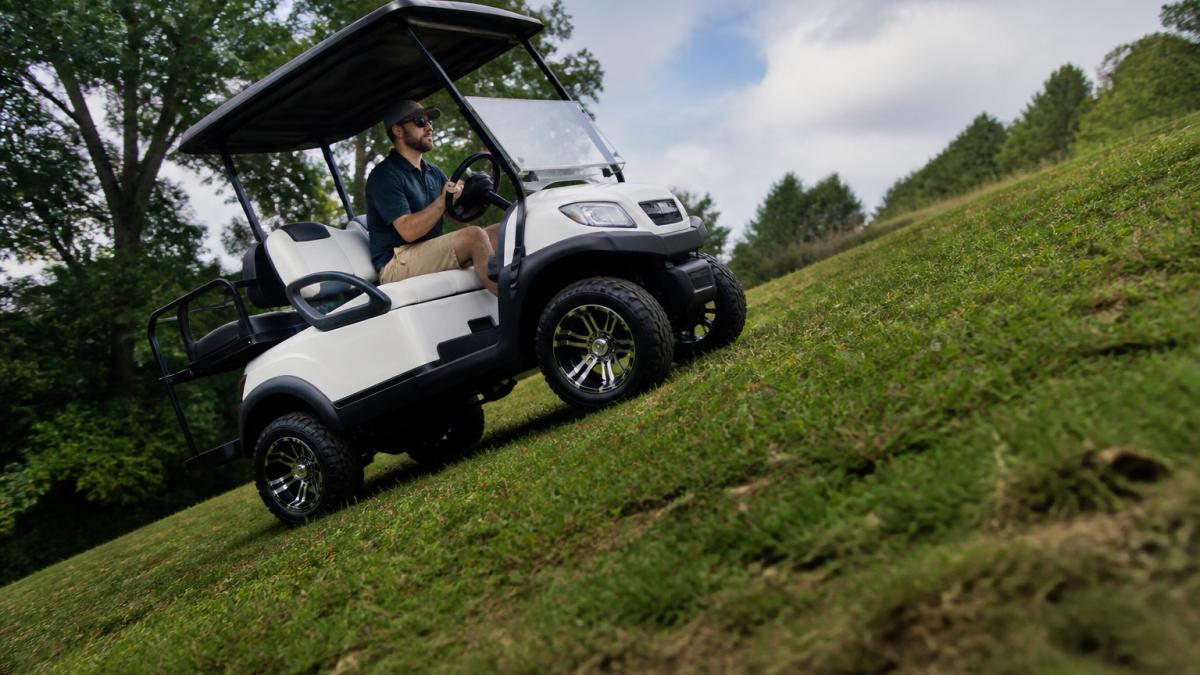
EZGO RXV: Best for Consistent Uphill Power
The EZGO RXV is purpose-built for hill climbing.
The RXV feels responsive because the electric motor generates full torque instantly. For residential users prioritizing straightforward hill climbing, it's the logical choice.
The firm suspension improves climbing stability but delivers a stiffer ride on rough terrain. For well-maintained roads, this is acceptable; for deeply rutted or rocky terrain, softer suspension is preferable.
Best for: Golfers and property owners requiring consistent power on steep terrain.
Pros:
- Excellent uphill acceleration
- Reliable downhill speed control
- Automatic parking brake for slope safety
Cons:
- Firm suspension feels less comfortable on rough ground
- 48V limits payload capacity on extreme grades
Cushman Hauler Pro: Best for Heavy Loads on Slopes
The Cushman Hauler Pro is a utility-focused cart built for work.
Its larger mass improves traction and stability on slopes. Rugged tires grip loose soil better than street-oriented tires. It's ideal for farm work, acreage management, or property maintenance on hilly ground.
The trade-off is maneuverability, it's built for straight-line hauling, not tight turns.
Best for: Utility and farm use where hauling capacity on hills is required.
Pros:
- High torque output for heavy loads
- Durable construction for rough terrain
- Excellent traction on loose surfaces
Cons:
- Less maneuverable than standard golf-sized carts
- Overkill for residential-only use
Epic Carts E40FX: Best for Residential Hill Climbing
The E40FX is designed for residential hill climbing with lifted suspension as standard, increasing ground clearance and stability. The enhanced motor delivers strong climbing performance with real-time battery monitoring.
The lifted suspension and motor enhancement justify the premium for hilly properties.
Best for: Residential use in hilly neighborhoods.
Pros:
- Strong hill-climbing capability
- Lifted suspension included as standard
- Premium features included, not as add-ons
Cons:
- Higher price point than entry-level models
- Overkill for flat-terrain properties
EA4x4 72V: Best for Off-Road and Extreme Terrain
The EA4x4 72V features a 4x4 drivetrain that distributes power to all four wheels, maximizing traction on loose, rocky, or rutted terrain.
It's engineered for challenging terrain with steep ravines, rocky hillsides, or forest trails. For standard residential hills, it's over-specified.
It's a significant investment. A 72V single-drivetrain cart like the Cushman Hauler Pro delivers 90% of the capability at substantially lower cost.
Best for: Off-road enthusiasts and those with extremely rugged, hilly terrain.
Pros:
- Superior traction on loose surfaces
- High power output for steep grades
- 4x4 drivetrain distributes force effectively
Cons:
- Premium pricing
- Overkill for moderate hill climbing
Club Car Onward: Best for Customization and Performance
The Club Car Onward is the customization platform.
Its appeal is flexibility: start with a standard configuration and upgrade components as needs evolve. Excellent aftermarket support offers dozens of verified upgrade paths.
The trade-off is complexity, customization requires knowledge and more decision-making than plug-and-play models.
Best for: Buyers looking for a balance of customization and hill-climbing performance.
Pros:
- Excellent aftermarket support
- Strong torque from lithium models
- Customizable suspension settings
Cons:
- Customization options can significantly increase total cost
- Requires more decision-making than pre-configured models
Yamaha Drive2: Best for Comfort on Varied Terrain
The Drive2 prioritizes ride quality without sacrificing climbing ability. Independent front suspension absorbs bumps more effectively than solid-axle designs, and gas or electric options provide flexibility.
Independent suspension allows each wheel to track terrain independently, improving stability on steep side-slopes. For daily users, this comfort matters.
Best for: Users seeking a smooth ride quality without sacrificing climbing ability.
Pros:
- Superior suspension comfort
- High build quality and reliability
- Available in gas or electric
Cons:
- May require specific motor upgrades for extremely steep, heavy-load applications
Golf Cart Hill Climbing Safety Tips
Hill climbing puts unique stress on carts and drivers. Understanding the physics and protocols prevents accidents and equipment damage.
Weight Distribution and Payload Considerations
Weight distribution directly affects stability on slopes. Unbalanced payload weight amplifies centrifugal forces that pull the cart toward the outside of the slope.
Load cargo low and centered to avoid raising the center of gravity. Distribute weight evenly side-to-side; unbalanced loads become dangerous on steep slopes.
Payload capacity decreases as slope angle increases. Check manufacturer guidelines for your specific terrain grade and reduce payload when in doubt.
Tire Tread and Traction on Steep Slopes
Tire tread depth directly correlates with traction on slopes. Worn tires slip on loose soil, gravel, or wet grass.
All-terrain tires grip better than street-oriented tires on uneven, hilly ground. If you regularly climb steep hills, all-terrain tires are worth the upgrade cost.
Tire pressure affects traction. Maintain your cart's recommended tire pressure consistently for optimal grip.
Hill Descent Control and Braking Protocols
Hill descent control automatically manages speed during steep descents, preventing runaway and brake fade. Use it to reduce driver workload and prevent brake overheating.
Without hill descent control, descend slowly using steady brake pressure rather than continuous braking, which generates heat and reduces effectiveness.
Common Mistakes to Avoid
The most common mistake is underestimating torque requirements.
Another frequent error is neglecting maintenance. Hill climbing stresses motors, brakes, and batteries more than flat-ground use.
Many users overlook suspension upgrades. A standard suspension feels harsh on rough, steep terrain.
Finally, don't ignore weight distribution.
Choosing the right golf cart for hilly terrain means matching motor torque, suspension design, and braking capability to your specific slopes and use case.
At Amplify Your Ride, we help customers select carts matched to their exact terrain and usage patterns.
Frequently Asked Questions
What features should I look for in a golf cart for hilly terrain?
Prioritize high-torque motors (48V or 72V systems), independent or lifted suspension for ground clearance, all-terrain tires with aggressive tread, and reliable braking systems like hill descent control. Check the torque-to-weight ratio and payload capacity relative to the incline grades you'll encounter. Regenerative braking helps extend battery life on downhill stretches. Test the cart on slopes similar to your property before purchasing.
Are electric or gas golf carts better for climbing hills?
Electric carts generally outperform gas on hills because electric motors deliver maximum torque instantly, making uphill acceleration smoother and more consistent. A 72-volt electric system provides superior climbing capability compared to 48-volt systems. Gas carts offer longer range and may handle extremely heavy payloads better, but require more maintenance. For residential hilly terrain, electric is typically the better choice due to lower operating costs and instant power delivery on steep slopes.
How much torque do I need in a high-torque golf cart motor for steep inclines?
Torque requirements depend on incline grade and payload. For residential slopes under 15 degrees, a 48-volt system with 50+ foot-pounds of torque works adequately. For grades between 15-25 degrees or when carrying passengers and cargo, a 72-volt system delivering 80+ foot-pounds is recommended. Extremely steep terrain (over 25 degrees) or heavy utility use requires specialized motors. Consult your cart dealer about your specific terrain to determine the right torque specification.
Do I need a lifted golf cart for hilly, uneven terrain?
Lifted suspension improves ground clearance and helps prevent undercarriage damage on rough, uneven slopes. It also raises the center of gravity, which can affect stability on steep side-slopes, so careful driving is essential. For mild residential hills with maintained paths, standard suspension may suffice. For property with significant rough terrain, deep ruts, or boulder-strewn slopes, lifted suspension with 4-6 inches of additional clearance is worth the investment for durability and safety.
What safety features are essential for driving golf carts on hills?
Install hill descent control to manage speed on downhill sections automatically. Verify the cart has reliable braking systems with adequate stopping power for slopes. Check that all-terrain tires provide sufficient traction and are properly maintained. Ensure the cart has a secure frame and stable suspension geometry to prevent tipping on side-slopes. Consider aftermarket modifications like roll cages or stability enhancements only from reputable manufacturers to avoid compromising the cart's structural integrity or warranty.