 Listicle
Why Lithium Batteries Win in Golf Carts
Last Updated: November 22, 2026
Quick Summary
Lithium batteries deliver more usable capacity, hold voltage under load, charge in a few hours, and need no watering, while lead-acid costs less upfront but demands regular maintenance. The trade is simple: pay more on day one for less weight, more power, and far fewer chores.
- A lithium pack weighs roughly one-third of a lead-acid set, so the cart accelerates better and climbs grades with less strain.
- Lithium reaches full charge in a few hours, while lead-acid needs six to twelve hours and dislikes interrupted charging.
- Lithium packs tolerate far more charge cycles than lead-acid sets, though exact service life depends on driving and charging habits.
- Never charge a lithium pack below freezing, and store it at roughly half charge in a cool, dry place.
- Pairing a lithium pack with an old lead-acid charger is the most common and most expensive conversion mistake.
Table of Contents
- Lithium vs Lead-Acid: The Comparison Table
- The Core Benefits of Lithium Batteries in Golf Carts
- How Many Years Will a Lithium Battery Last in a Golf Cart?
- How Much Do Lithium Batteries Cost for a Golf Cart?
- The Golf Cart Lithium Battery Conversion Kit Explained
- Problems With Lithium Batteries in Golf Carts
- Real-World Range, Cold Weather and Who Should Not Switch
- Book a Lithium Upgrade Assessment at Amplify Your Ride
- Frequently Asked Questions
Lithium vs Lead-Acid: The Comparison Table
The benefits of lithium batteries in golf carts come down to one trade: you pay more upfront and get less weight, more usable power, and far fewer chores.
Here is the short version before we get into the details. A lithium battery pack generally delivers more of its rated capacity, holds voltage under load, and needs no watering.
| Factor | Lithium (LiFePO4) | Lead-Acid |
|---|---|---|
| Weight | Roughly one-third of lead-acid | Heavy, four to six units |
| Charging time | A few hours, no memory issues | Six to twelve hours |
| Maintenance | None, no watering | Water levels, terminal cleaning |
| Usable capacity | Most of rated capacity | Less under heavy load |
| Cycle life | Far more charge cycles | Fewer cycles before replacement |
| Upfront cost | Higher | Lower |
| Cold weather | Needs care when charging | Tolerates cold better |
That table is the whole argument in miniature. Everything below explains why each row matters in practice.
The Core Benefits of Lithium Batteries in Golf Carts
The headline benefit is simple: a lithium battery pack turns a cart that needs attention into a cart you just plug in and drive. That single change is what convinces most of our customers to convert.
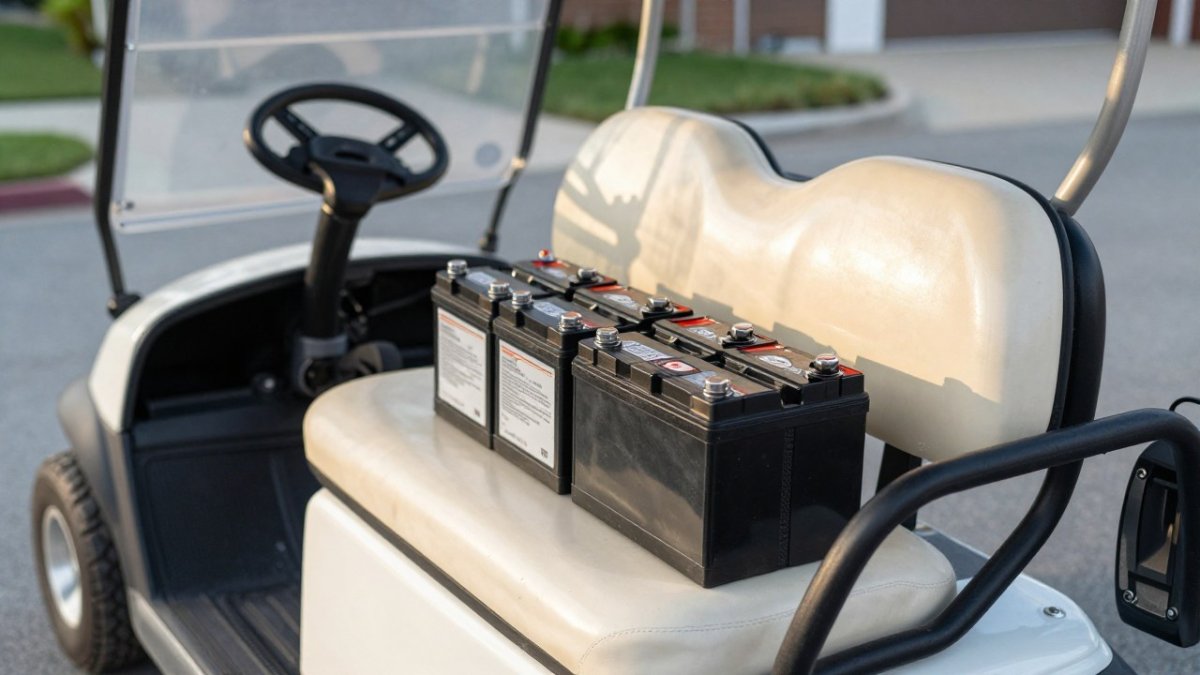
Less Weight, More Usable Capacity
Weight is the benefit people underestimate. Swapping a bank of lead-acid units for a single lithium pack removes a serious amount of mass from under the seat.
Usable capacity matters just as much. A lead-acid battery sags under load, so a hill or a full passenger load eats into your range. Lithium holds voltage steadier, so more of the rated amp-hours actually reach the motor.
Faster Charging and No Watering
Charging time is where lithium wins daily. A lithium pack reaches full charge in a few hours, so an overnight top-up is more than enough. Lead-acid needs a long, slow charge and does not like being interrupted.
Then there is the watering. If you are weighing charger repairs against a new setup, our breakdown of golf cart battery charger repair costs covers what to expect.
How Many Years Will a Lithium Battery Last in a Golf Cart?
Lithium packs generally tolerate far more charge cycles than lead-acid sets. Exact service life depends on how hard you drive and how you charge.
Cycle life is the number that matters. Every full discharge and recharge counts as a cycle, and lithium chemistries tolerate far more of them than lead-acid.
If you are buying used, check the battery age before you commit. Our guide on how old your golf cart batteries are shows how to read date codes and spot a pack near the end of its life.
How Much Do Lithium Batteries Cost for a Golf Cart?
Lithium generally costs more upfront than lead-acid. What most buyers actually need is a way to compare the two chemistries on the same footing over the years they will own the cart.
What Drives the Upfront Price
A lithium golf cart pack is priced by four variables: voltage (48V is the most common conversion target), capacity in amp-hours, brand and cell grade, and whether a compatible charger and installation are bundled in. A larger pack with more usable capacity costs more than a smaller one, and a kit that includes a lithium-rated charger costs more than a bare pack. Because those variables swing widely by cart, we quote each conversion individually rather than publish a number that will not fit your cart. For a full breakdown of what replacement involves, see our golf cart battery replacement cost guide.
Total Cost of Ownership: The Assumptions That Matter
Rather than assuming lithium saves money over time, build the comparison yourself with five inputs. The result depends heavily on your own numbers.
- Purchase price. The lithium pack plus BMS plus compatible charger versus a full lead-acid set. Lead-acid wins this line every time.
- Replacement interval. Lead-acid packs are typically replaced several times over the life of a cart that a single lithium pack can serve. Count how many lead-acid sets you would buy in the same span.
- Charging cost. Both chemistries draw wall power, but lithium charging is more efficient and finishes faster, so the electricity line is smaller per mile driven. Multiply your local electric rate by the pack's capacity and your charging frequency to estimate it.
A common pattern is that the lead-acid "cheaper" option wins on day one and loses on every subsequent line. If you want the full picture on service and upkeep, our golf cart maintenance cost breakdown lays out the recurring expenses to plan for.
Watch out: comparing a lithium pack price to a single lead-acid battery price instead of a full lead-acid set is the most common way buyers talk themselves into the wrong conclusion. Compare like for like, full pack to full pack, including the charger.
The Golf Cart Lithium Battery Conversion Kit Explained
A conversion kit is the package that lets a lead-acid cart run on lithium: the battery pack, a battery management system, mounting hardware, and usually a charger matched to the new pack.
Compatibility is where conversions go wrong. Before buying anything, confirm these points:
- Cart voltage matches the kit voltage
- The charger is rated for lithium, not lead-acid
- The BMS is included and sized for the pack
Watch out: pairing a lithium pack with an old lead-acid charger is the most common and most expensive mistake. The charger will not manage the pack correctly and can shorten its life.
Problems With Lithium Batteries in Golf Carts
Lithium is not flawless, and anyone who says otherwise is selling something. The real problems with lithium batteries in golf carts are cost, cold, and compatibility, not performance.
The upfront price is the obvious one. Cold weather is the second: lithium packs should not be charged below freezing, so unheated storage in winter needs a plan. Compatibility is the third, and it is why a checklist beats a guess.
Real-World Range, Cold Weather and Who Should Not Switch
Range claims on paper rarely match real driving, and the reasons are mechanical, not mysterious. Understanding what pulls the number down lets you predict your own range instead of trusting a brochure.
What Actually Moves Your Range
A lithium pack's usable energy is fixed, but the energy required to move the cart changes with every trip. The biggest factors, roughly in order of impact:
- Terrain. Hills are the single largest drain. Climbing a grade requires far more current than cruising flat ground, and a cart that covers a flat neighborhood loop with ease will use noticeably more energy on repeated grades.
- Passenger and cargo weight. Every additional passenger and every pound of cargo adds to the mass the motor must accelerate and hold against gravity. A two-passenger cart and a four-passenger cart with a loaded bed are different range vehicles.
- Speed and driving style. Energy use rises steeply with speed because aerodynamic drag and rolling resistance both increase. Hard acceleration and repeated stop-start driving cost more than steady cruising.
- Temperature. Cold reduces the usable capacity a lithium pack can deliver and restricts charging until the cells warm up. This is covered in more detail below.
A practical way to estimate your own range: start from the pack's rated capacity, then discount it for your typical terrain and load. Most practitioners find that a cart driven on flat ground with two passengers gets close to the rated figure, while the same cart on hilly ground with four passengers and cargo should be planned around a meaningfully lower number.
Cold Weather: Charging, Storage, and Range
Cold is the ownership question that benefit-focused articles skip, and it matters in much of the country. Lithium iron phosphate (LiFePO4) packs should not be charged below freezing.
- Charging. Do not charge a cold-soaked pack. Let it warm to above freezing first, or use a pack with low-temperature charge protection and, if available, internal heating. Never override a BMS that is refusing to charge.
- Storage. For winter storage, charge the pack to a partial state, most manufacturers recommend roughly half charge rather than full, disconnect it, and store it in a cool, dry place above freezing if possible. Check and top up the charge periodically per the manufacturer's guidance.
- Range in cold. Expect usable range to drop in cold weather even when the pack is healthy. Plan shorter trips and charge more often rather than relying on summer range figures.
- Warming up. A pack that has warmed through normal use will accept charge and deliver closer to its rated capacity than one that has sat cold overnight.
Watch out: leaving a lithium pack at full charge in freezing storage, or forcing a charge on a cold pack, is the fastest way to shorten its life. Follow the manufacturer's cold-weather instructions rather than improvising.
Who Should Not Switch Yet
Some owners should not switch yet. If your cart is near the end of its life, or your driving is light and your lead-acid pack is healthy, the math may not favor a conversion today. If you drive steep hills daily, read our guide to the best golf carts for hilly terrain before you commit to a conversion.
Book a Lithium Upgrade Assessment at Amplify Your Ride
The right lithium setup depends on your cart, your terrain, and how you actually drive it. Guessing at voltage and capacity is how people end up with a pack that underperforms or a charger that fights the battery.
Amplify Your Ride sells new EPIC, Star EV, and Greyson golf carts and new and used golf carts, and offers service, repair, and parts.
A lithium upgrade is a real decision, not an impulse buy.
Frequently Asked Questions
Are lithium batteries worth it for a golf cart?
For most owners who drive regularly, yes. A lithium pack delivers more usable capacity from the same rated amp-hours, so range per charge goes up, and it charges in a fraction of the time a lead-acid set needs. You also skip watering and equalizing. The math turns on how long you keep the cart, since a longer-lived lithium pack spreads its higher upfront cost across more years of service.
What is the downside to lithium batteries?
The main drawbacks are upfront cost and cold sensitivity. A lithium pack costs more at purchase than a comparable lead-acid set, and charging below freezing can damage the cells unless the pack has low-temperature cutoff. Lithium also needs a compatible charger, so you cannot reuse an old lead-acid charger. Finally, lithium is not the right call for a cart that sits unused for months at a time without a maintainable storage plan.
Can you convert a golf cart from lead-acid to lithium batteries?
Yes, and a golf cart lithium battery conversion kit makes it straightforward on most 36V and 48V carts. The kit bundles the pack, a matched charger and mounting hardware. Before ordering, confirm your cart's voltage, check that the controller and motor are rated for the pack's output, and verify the physical tray dimensions.
How much do lithium batteries cost for a golf cart?
Pricing depends on voltage, amp-hour capacity, brand and whether a charger is included, so there is no single figure. A 48V pack for a standard cart sits in a different bracket than a large-capacity pack for a lifted cart with big tires. Ask for a quote that lists the pack, charger, installation and any controller work separately, then compare that total against the number of lead-acid replacements you would buy over the same years.