 blog
blog
Custom Golf Cart Accessories for Sale: 2026 Buyer's Guide
Table of Contents
- What to Know Before Buying Custom Golf Cart Accessories
- Golf Cart Wheel and Tire Packages: All-Terrain and Street Options
- Lift Kits and Suspension Upgrades for Custom Golf Carts
- Golf Cart LED Light Bar Installation and Lighting Upgrades
- Street Legal Golf Cart Conversion Kits: What You Need
- Seating, Storage, and Comfort Accessories
- Performance Upgrades: Batteries, Motors, and Charging
- Why Fitment and Maintenance Decide Your Build
- Frequently Asked Questions
Last Updated: September 25, 2026
What to Know Before Buying Custom Golf Cart Accessories
Shopping for custom golf cart accessories for sale starts with one question: what will this cart actually do? A lifted trail cart on a Serenbe property needs different parts than a street-legal neighborhood cruiser. Shopping for custom golf cart accessories for sale starts with one question: what will this cart actually do? A lifted trail cart on a Serenbe property needs different parts than a street-legal neighborhood cruiser.
Golf Cart Wheel and Tire Packages: All-Terrain and Street Options
Wheel and tire packages are where most builds start, because they change both looks and handling. Street tires prioritize a smooth, quiet ride on pavement; all-terrain tires trade road comfort for grip on gravel, grass, and dirt.
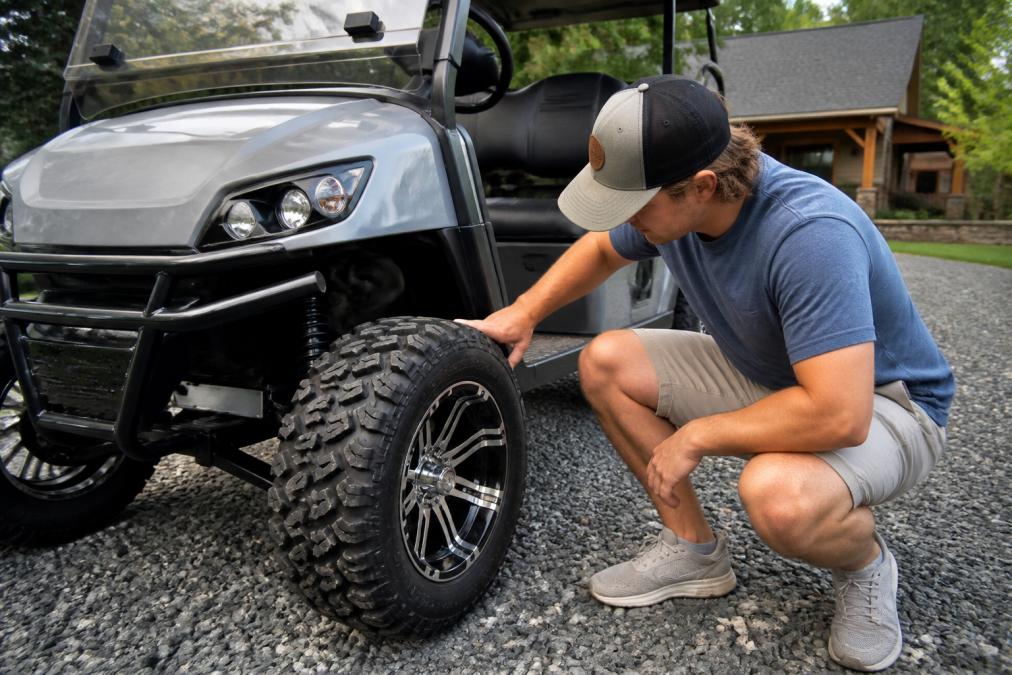
- Street packages: smooth tread, quiet ride, best for paved neighborhood paths
- All-terrain packages: deeper tread, better traction on gravel and grass
- Lifted packages: larger diameter, requires a lift kit and clearance check
Lift Kits and Suspension Upgrades for Custom Golf Carts
A lift kit raises the cart's body to clear larger tires and improve ground clearance. Suspension upgrades go further, replacing springs and shocks to handle rougher terrain and heavier loads without bottoming out. The two are usually sold together but solve different problems, confusing them is how buyers end up with a cart that rides worse than stock.
How Lift Kits Actually Work
Most lifts fall into two mechanical families:
- Spindle lifts replace the front spindles and add blocks or spacers at the rear. They are the most common entry-level option because they are inexpensive and bolt on with hand tools. The trade-off: a spindle lift doesn't change suspension geometry, it just moves the body up, so ride quality on rough ground stays close to stock.
- A-arm (double A-arm) lifts replace the front suspension with new control arms, often paired with upgraded coil springs and shocks. They cost more and take longer to install, but they correct camber and caster, keeping steering predictable after the cart is raised.
- Long-travel kits are the extreme end, adding several inches of suspension travel for trail and off-road use. They typically require new brake lines, longer shocks, and sometimes a steering column extension.
Matching Lift Height to Tire Size
Lift height and tire diameter are locked together. A lift that clears a 20-inch tire won't clear a 23-inch tire, and a tire that fits at rest can rub the fender the moment you turn or hit a bump. As a working rule of thumb:
| Lift Height | Typical Max Tire Diameter | Notes |
|---|---|---|
| 3 inch | 20 inch | Fits most stock frames, minimal geometry change |
| 4 inch | 22 inch | Common street-and-trail compromise |
| 6 inch | 23 inch | Often needs brake line extensions and a steering column extension |
| 8 inch and up | 25 inch and up | Long-travel territory; expect drivetrain and brake work |
The Compatibility Checks That Prevent Expensive Mistakes
Before ordering any lift, confirm four things:
- Frame and axle rating. A lift adds leverage to the frame and axle. Some frames handle it; some don't, and overloading them is a warranty and safety issue.
- Brake line length. Lifting the body stretches stock brake lines. If too short, you need extensions, and on some carts, a proportioning valve adjustment.
- Steering geometry. Above roughly 4 inches, most carts need a steering column extension or dropped pitman arm to keep the steering wheel angle usable.
- Wheel offset. The wrong offset will rub the fender or suspension arm even if tire diameter is within range.
Suspension Upgrades Beyond the Lift
A lift alone doesn't make a cart ride better. If you carry passengers or cargo, heavy-duty leaf springs and upgraded shocks reduce sag and bottoming out. On lifted carts, a rear sway bar or upgraded bushings offsets the higher center of gravity, which is what makes sharp turns feel less planted. On gravel or trails, shocks change ride quality the most, more than lift height itself.
Installation Reality
A spindle lift is a weekend job for a confident DIYer with jack stands, a torque wrench, and a helper. An A-arm or long-travel kit involves disconnecting brake lines, aligning the front end, and re-torquing suspension hardware to spec. If you're not comfortable with suspension work, hand this to a shop, a poorly torqued lift kit is a safety issue, not just a performance one.
Golf Cart LED Light Bar Installation and Lighting Upgrades
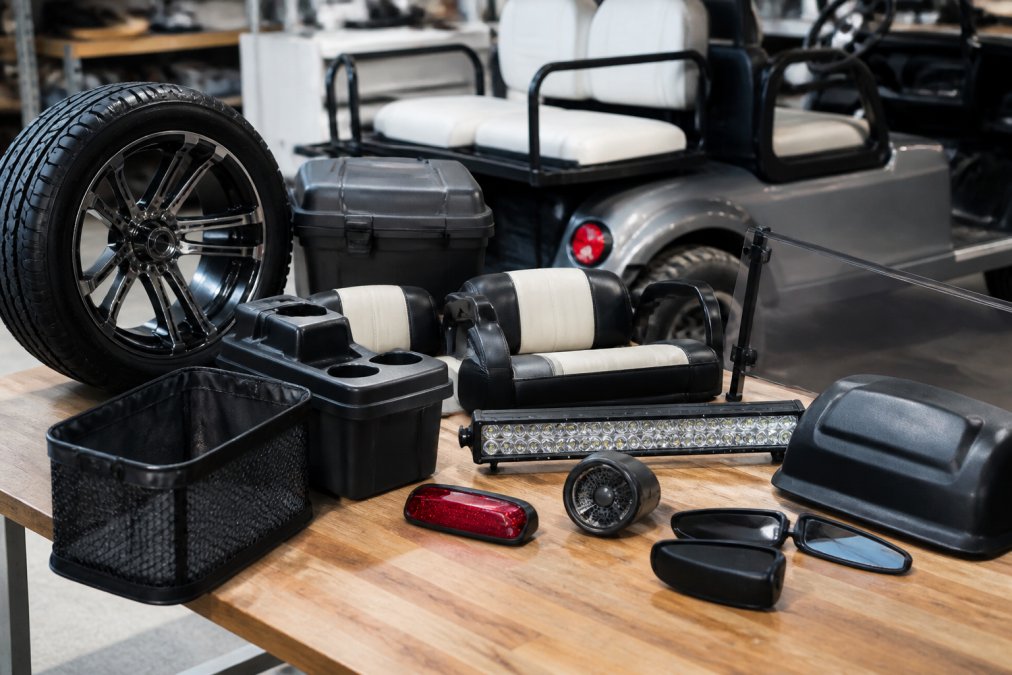
Golf cart LED light bar installation is one of the most popular upgrades because it improves visibility and gives a cart a custom look. A light bar mounts to the roof or front bumper and wires into the cart's electrical system, often through a voltage reducer.
Beyond light bars, common lighting upgrades include:
- Headlight and taillight kits for road visibility
- Turn signal kits for street-legal conversions
- Underbody accent lighting for a custom look
- Side mirrors with integrated signals for added safety
Street Legal Golf Cart Conversion Kits: What You Need
Street legal golf cart conversion kits add the equipment that lets a cart operate on public roads where local rules allow it. Typical kits bundle headlights, taillights, brake lights, turn signals, mirrors, a horn, and a license plate bracket. But a kit alone doesn't make a cart legal, the rules that decide whether you can drive on a public road are set locally, not by the kit manufacturer.
Who Actually Regulates This
There's no single federal standard for low-speed vehicles that maps cleanly onto golf carts. In practice, three layers of rules apply:
- State motor vehicle agencies decide whether a golf cart or low-speed vehicle (LSV) can be registered and titled for road use, and what equipment is required.
- State and local traffic law sets where a cart may operate, often restricted to roads with posted speed limits at or below a certain threshold, frequently 25 or 35 mph depending on the state.
- Municipal or homeowner association rules can be stricter than state law, especially in planned communities and on private roads.
The Equipment Checklist Most Jurisdictions Expect
While specifics vary, the equipment list for a road-legal cart is fairly consistent. Use this as a starting checklist, then confirm each item locally:
- Headlights and taillights, often required to be on whenever the cart is on a public road
- Brake lights that illuminate when the brake pedal is pressed
- Turn signals front and rear, with a self-canceling or clearly visible indicator
- A horn audible at a reasonable distance
- Side and rearview mirrors, many jurisdictions require at least one mirror, some require two
- A windshield, often required, and sometimes required to be safety glass rather than acrylic
- Seat belts for every seating position
- A license plate bracket and light if the cart will be registered
- Reflectors or reflective tape on the rear and sides
Registration, Insurance, and Licensing
If your cart qualifies as a low-speed vehicle, expect to register and title it, carry liability insurance, and in many states hold a valid driver's license to operate it on public roads. Some states require a specific license class or endorsement. Registration fees, inspection requirements, and insurance minimums are set locally, so numbers you see online for one state won't match another.
Matching the Kit to the Rules, Not the Other Way Around
A conversion kit is a starting point, not a guarantee. Build your shopping list from your jurisdiction's actual requirements, then confirm the kit's components match item by item. Buying a generic kit and discovering it's missing a required item, or includes a light that doesn't meet a local standard, wastes time and money. If converting for a specific community, check that community's rules first; HOA and municipal requirements are often the binding constraint, not state law.
A Note on Installation and Wiring
Most conversion kits wire into the cart's existing harness, but carts run on a higher-voltage battery pack than a standard 12-volt accessory circuit. Tapping the wrong terminals can drain one battery unevenly and shorten pack life, which is why a voltage reducer is standard practice for lights, signals, and audio. If your kit includes turn signals and brake lights, plan the wiring as one system rather than piecemeal, rewiring twice is the most common cost overrun on a conversion.
Seating, Storage, and Comfort Accessories
Seating and comfort upgrades turn a basic cart into something you actually want to spend a day in. Custom seat covers protect against sun and spills, and rear flip seats add passenger capacity that converts to a cargo bed when you need to haul.
The categories worth knowing:
| Category | What It Adds | Best For |
|---|---|---|
| Custom seat covers | Protection and style | Daily drivers, sun exposure |
| Rear flip seat | Passenger or cargo flexibility | Families, hauling |
| Dash console | Storage and organization | Keeping essentials handy |
| Floor mats | Easy cleanup | Wet or dusty conditions |
| Roof rack | Extra cargo space | Trips with gear |
Performance Upgrades: Batteries, Motors, and Charging
Performance upgrades are about matching power delivery to how you use the cart. A battery upgrade extends range and can improve acceleration, while a performance motor delivers more torque for hills and heavier loads.
Why Fitment and Maintenance Decide Your Build
The parts you choose matter, but how they fit together and how you maintain them matter more. A compatibility check before every purchase prevents the most expensive mistakes, and a simple maintenance routine keeps custom parts working longer.
Frequently Asked Questions
Are custom golf cart accessories compatible with all brands?
Not always. Fitment varies by brand and model year, so you need a compatibility check before buying. Lift kits, wheels, and windshields are the most brand-specific. Most aftermarket parts list the cart models they fit, and a dealer can confirm fitment. If you are unsure, measure your cart's bolt pattern and suspension setup, or bring your cart to a shop that stocks custom golf cart accessories for sale and can test-fit parts before you commit.
What safety accessories should every golf cart have?
At minimum, add a turn signal kit, side mirrors, and a horn if you drive on or near roads. LED light kits improve visibility, and a voltage reducer keeps your accessories from draining the main battery pack. For carts used at night or in low light, a golf cart LED light bar installation gives you much better forward visibility than stock headlights. Brake lights and reflectors are also worth adding, especially for street legal golf cart conversion kits.
How do I choose the right lift kit for my golf cart?
Start with how you use the cart. A 3-inch lift fits most all-terrain tires and works for neighborhood driving. A 6-inch lift handles larger tires and rougher ground but changes steering feel. Check that your wheel and tire package clears the suspension, and confirm the kit includes heavy-duty springs and installation hardware. If you are not comfortable with the install, a dealer can handle it and check alignment afterward.
How can I improve the performance of my golf cart with accessories?
The biggest gains come from a battery upgrade and a performance motor, especially on lifted carts with larger tires. A voltage reducer protects your electronics when you add lights and audio. For gas carts, performance tuning and a fresh air filter help. Pair these with a suspension upgrade so the cart handles the extra speed and weight. Talk to a shop about what your specific cart needs before buying parts.
Customizing a golf cart is rewarding when the parts fit and the wiring is right, and frustrating when they don't. The difference usually comes down to one thing: buying from someone who checks compatibility before the sale. Amplify Your Ride carries new and used carts, service, rentals, and parts, and helps you match accessories to your exact model. Get started with Amplify Your Ride and build a cart that fits how you actually ride.