 blog
blog
Prime vs. Botero Golf Carts: A 2026 Buyer's Guide
Table of Contents
- Prime vs. Botero Golf Carts: Key Differences at a Glance
- Prime Golf Carts Reviews: What Owners and Dealers Report
- Botero Golf Carts Reviews: Reliability, Design, and Customer Feedback
- Prime vs. Botero Golf Cart Warranty: Coverage and Protection
- Golf Cart Range and Battery Life: Prime and Botero Compared
- Pricing, Value, and Total Ownership Costs
- Which Cart Should You Choose? A Buyer's Framework
- Conclusion
- Frequently Asked Questions
Last Updated: October 14, 2026
Prime vs. Botero Golf Carts: Key Differences at a Glance
When comparing prime vs botero golf carts, the choice comes down to upfront cost, long-term reliability, warranty coverage, or customization. Prime golf carts appeal to budget-conscious buyers seeking straightforward reliability, while Botero carts attract owners who want premium features and will pay more for them.
Neither is universally "better", the right choice depends on your priorities, budget, and usage.
Here's what separates them:
| Feature | Prime Golf Carts | Botero Golf Carts |
|---|---|---|
| Price Range | Budget to mid-range | Mid-range to premium |
| Battery Options | Lead-acid, lithium available | Lithium standard, lead-acid options |
| Warranty Coverage | Varies by model | Extended options, eight-year available |
| Customization | Limited factory options | Extensive custom options |
| Design Focus | Practical, utilitarian | Style-forward, aesthetic appeal |
| Service Support | Dealer-dependent | Strong dealer network |
Prime Golf Carts Reviews: What Owners and Dealers Report
Prime golf carts have built a reputation as dependable workhorses. Owners report they start reliably, handle local terrain, and don't require constant attention.
The common feedback centers on customization limitations.
Battery life varies by model and type.
Reliability reviews are generally positive. Most reported issues are minor, loose connections, electrical glitches, rather than structural, and rust isn't common among owners who maintain basic care.
Botero Golf Carts Reviews: Reliability, Design, and Customer Feedback
Botero carts stand out for their design-forward approach: built to look good while performing well, which matters where carts are a visible part of daily life.
Performance-wise, Botero carts deliver solid reliability with a focus on driver experience: more intuitive touchscreens, more comfortable seating, and a more refined cabin than entry-level Prime models.
Botero leans heavily toward lithium: better range, faster charging, less maintenance than lead-acid, and consistent performance even after hundreds of cycles.
Prime vs. Botero Golf Cart Warranty: Coverage and Protection
Warranty is the biggest risk-transfer decision in this comparison, yet most ranking pages mention it only in passing. Treat every figure below as a verification item, not a promise: terms change by model year, dealer, and battery supplier, so confirm the current written document before you sign.
What to compare, line by line
| Warranty element | Prime (typical) | Botero (typical) | Why it matters to you |
|---|---|---|---|
| Frame / structural | Limited term, often around 12 months on new carts, model-dependent | Extended structural coverage advertised on many models, up to eight years on the frame | Frame repairs are the most expensive out-of-pocket failure |
| Powertrain (motor, controller) | Limited, dealer-dependent | Longer stated terms on premium trims | Controllers and motors are the second-most-common major failure |
| Lead-acid battery | Short, commonly around 12 months, prorated in some programs | Available but not the standard configuration | Prorated coverage often pays a fraction of replacement cost |
| Lithium battery | Optional upgrade; coverage tied to the battery supplier, not always the cart maker | Often five years or longer through the battery manufacturer | This is the largest single cost difference over a 7-10 year hold |
| Cosmetic / paint / finish | Usually excluded or very short | Often marketed as a durability feature; confirm whether fading is actually covered | "Finish holds up" marketing is not the same as a written cosmetic warranty |
| Transferability to a used buyer | Frequently non-transferable or requires a fee and paperwork window | Varies; some programs allow transfer within a set number of days of resale | Determines whether a used cart carries any remaining protection at all |
| Exclusions | Water/flood damage, unauthorized modifications, aftermarket lift kits and electronics, lack of scheduled maintenance | Similar exclusions; aftermarket parts can void the affected system | The modifications buyers want most are often the ones that void coverage |
The exclusions matter more than the term length
A long warranty headline is only as good as its exclusion list. Across both brands, read these recurring exclusions carefully:
- Water intrusion and flood exposure. Nearly universal exclusion, and the hardest to detect on a used cart.
- Unauthorized modifications. Aftermarket lift kits, controllers, and stereo/lighting wiring commonly void the affected system, and sometimes the whole electrical warranty.
- Failure to perform scheduled maintenance. If the warranty requires documented service intervals, missing records can be used to deny a claim.
Repair turnaround and pickup policy
Warranty length is meaningless if service takes three weeks. Ask each dealer in writing:
- Do you perform warranty repairs in-house, or do you ship the cart or the component out?
- What is your typical turnaround for a battery claim versus a controller claim?
- Is pickup and delivery included during the warranty period, or is it billed per trip?
- Is there a mobile-service option, and does it carry a trip charge?
- Who is my point of contact when a claim is denied, and what is the escalation path?
Owners commonly report the brand's warranty is fine but dealer capacity is the bottleneck, a dealer question, not a brand question, and why two buyers of the same cart can have very different experiences.
The used-cart reality
On a used purchase, assume coverage is limited or gone unless you can produce transfer paperwork, which shifts the risk onto your pre-purchase inspection. Before buying, verify:
- Frame for rust, especially around battery trays and welds
- Battery date codes and whether the pack has been replaced
- Any sign of standing water, silt, or corrosion in the controller compartment
Golf Cart Range and Battery Life: Prime and Botero Compared
Range depends on battery type, cart weight, and terrain, so comparing prime vs botero golf carts requires knowing which battery each uses.
Prime carts with lead-acid batteries typically deliver 30-50 miles per charge, adequate for neighborhood use but requiring frequent charging for daily use.
Botero carts, with standard lithium, typically achieve 70-100 miles per charge, reducing charging frequency and adding flexibility for longer trips.
Battery longevity matters equally.
Charging time differs too: Prime lead-acid needs 8-12 hours for a full charge, while Botero lithium reaches 80% in 4-6 hours.
Pricing, Value, and Total Ownership Costs
Ranking pages for this query say one brand is "better value" and stop. Value isn't a sticker price; it's the total you spend from purchase through resale. Below is a framework to fill in with current dealer quotes.
Step 1: Get like-for-like quotes
A Prime-versus-Botero price comparison is meaningless unless the carts are configured the same way. Ask for a written quote on each with these line items:
| Line item | Prime quote | Botero quote |
|---|---|---|
| Base cart, stated model year | ||
| Battery type and capacity (lead-acid vs. lithium, kWh) | ||
| Charger included? | ||
| Wheels and tires | ||
| Lift kit, if any | ||
| Lighting and accessories | ||
| Seating configuration | ||
| Delivery / setup / destination fee | ||
| Tax, title, registration if applicable | ||
| Out-the-door total |
If a dealer won't itemize, that itself is information. Destination and setup fees are a common place a lower advertised price quietly catches up to a higher one.
Step 2: Financing and the real cost of the money
Both brands are commonly financed through dealer-arranged lenders or a manufacturer program. Compare:
- APR, not just the monthly payment
- Term length (a longer term lowers the payment and raises total interest)
- Down payment required
A promotional low APR on one brand can beat a lower sticker price on the other once interest is included. Run both quotes through the same term length.
Step 3: Build a five-year ownership model
The line items that separate these brands over time are battery replacement, maintenance, and resale. Fill in your own numbers using current local quotes:
| Cost category | Prime (lead-acid typical) | Prime (lithium upgrade) | Botero (lithium typical) |
|---|---|---|---|
| Purchase price | |||
| Battery replacement, year 3-5 | Likely one replacement in this window | Possibly deferred past year 5 | Possibly deferred past year 5 |
| Annual maintenance (water, terminals, service) | Higher touch | Lower touch | Lower touch |
| Charging electricity, annual | |||
| Warranty repairs out of pocket | |||
| Estimated resale at year 5 | |||
| Net five-year cost |
The mechanism is simple: a lead-acid pack needs replacement sooner and costs a meaningful fraction of the cart's value, while lithium costs more upfront and lasts longer. If the upfront price gap is smaller than one lead-acid replacement plus the maintenance difference, the cheaper cart isn't actually cheaper over five years.
Step 4: Used-market pricing logic
Used pricing tracks three things more than brand reputation:
- Battery age and type. A used cart with a lithium pack that is two years old is worth substantially more than the same cart with a lead-acid pack of unknown age.
- Documented service history. Records raise the price a seller can defend and lower your risk.
- Cosmetic and structural condition. Frame rust and flood exposure are the two conditions that should end the negotiation.
A practical rule: price a used cart as if you'll replace the battery within 12 months unless the seller shows a recent replacement with a matching date code.
Step 5: Resale and hold value
Premium carts with lithium and factory customization generally hold value better in percentage terms, since the features buyers want are installed and the battery has remaining life. Budget carts with aging lead-acid packs lose value faster near end of life.
Which Cart Should You Choose? A Buyer's Framework
The right choice depends on four factors: budget, usage pattern, customization priorities, and long-term ownership plans.
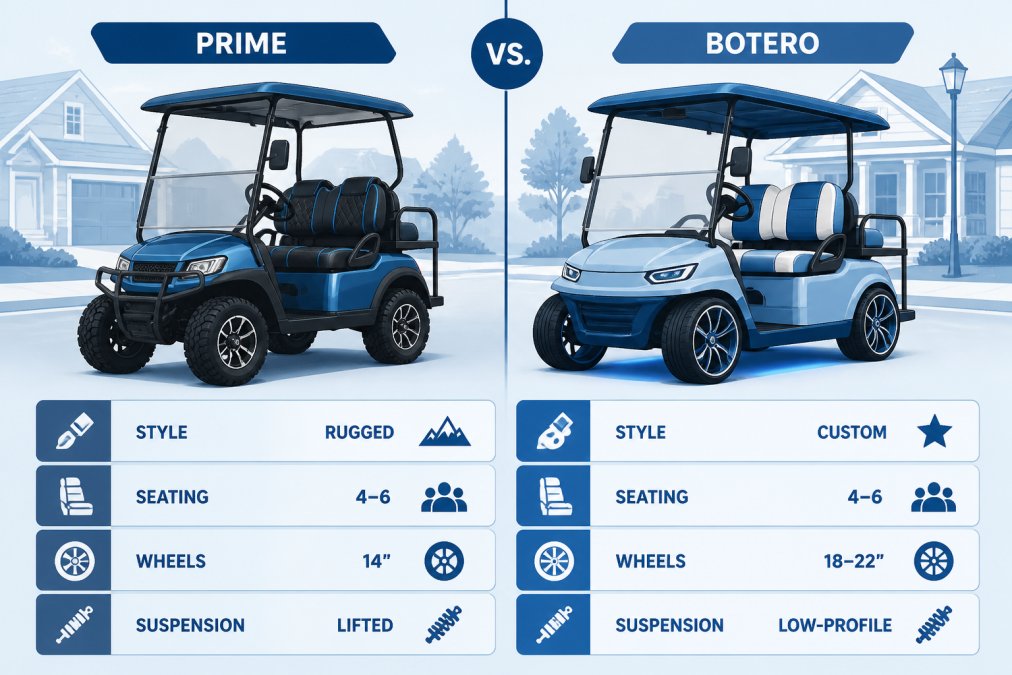
Choose Prime if:
- Budget is your primary constraint
- You use the cart occasionally or seasonally
- You prefer simplicity and don't need extensive customization
Choose Botero if:
- You use the cart daily or plan extended ownership
- Design and aesthetic appeal matter to you
- You want factory customization options without hunting for aftermarket parts
A practical decision framework:
- Calculate your annual usage. Daily users benefit from Botero's extended range and lithium efficiency. Seasonal users can manage with Prime's lead-acid option.
- Assess customization needs. If you want specific features or aesthetic changes, Botero's factory options save time and frustration.
- Compare total ownership cost, not sticker price. Factor in battery replacement, maintenance, and warranty coverage over five years.
- Inspect used carts thoroughly. Flood damage, frame rust, and battery condition matter more than brand name for used purchases.
- Test drive both if possible. Comfort, visibility, and controls differ between brands. What works for someone else might not suit your preferences.
Conclusion
Prime and Botero golf carts serve different buyer profiles, and neither is objectively "better." Prime delivers reliable, budget-friendly transportation; Botero offers premium features, extended warranty protection, and lower long-term ownership costs.
The decision hinges on your priorities: immediate affordability versus long-term value, simplicity versus customization, and occasional use versus daily reliance.
Frequently Asked Questions
How do Prime and Botero golf carts compare in price?
Pricing for both Prime and Botero golf carts depends on model, battery type, customization, and delivery. New carts typically cost more than used inventory. For current pricing and a quote tailored to your needs, contact a local dealer directly. Comparing upfront cost alone misses total ownership, factor in warranty coverage, battery lifespan, and service availability when evaluating value.
Which golf cart brand offers better warranty coverage, Prime or Botero?
Warranty terms vary by model and dealer. Prime carts often feature competitive coverage on batteries and drivetrain components, while Botero carts typically include factory protection plans. Before purchasing, request the full warranty document from your dealer and confirm what parts and labor are covered, what voids coverage, and whether service is available locally.
How do Prime and Botero carts compare for range and battery life?
Range and battery life depend on battery type (lithium versus lead-acid), cart weight, terrain, and driving habits. Lithium batteries generally deliver longer range and faster charging than traditional lead-acid options. Both brands offer models with lithium upgrades. Ask your dealer for real-world range estimates on the specific model you're considering, and confirm battery warranty length and replacement costs.
What should I inspect before buying a Prime or Botero golf cart?
For used carts, inspect the frame for rust or water damage, check battery condition and age, test acceleration and braking, examine tires for wear, and verify service history. Ask the dealer about any prior flood or frame damage. For new carts, confirm all factory equipment matches the order, test the touchscreen and accessories, and review the warranty document. A reputable dealer will encourage inspection and answer technical questions before you commit.
When you're ready to explore your options, Amplify Your Ride can help you evaluate both new and used carts, explain warranty differences, and match you with a cart that fits your actual needs, not just your budget. We carry multiple brands, offer professional inspection and service, and can walk you through the real ownership costs so you make an informed choice. Contact us to discuss which cart makes sense for your situation.