 blog
7 Golf Cart Battery Charger Repair Costs You Should Expect
Last Updated: October 25, 2026
Quick Summary
Golf cart battery charger repair cost depends on which component failed, ranging from $30-$90 for a fuse, cord, or connector fix to $450-$1,000+ for an onboard charger module. Control board repairs run $180-$450 and transformer repairs $300-$700, with labor and diagnostic fees adding to the total.
- A professional diagnostic often includes bench testing, load testing, and a written fault report.
- A charger 10-15 years old is more likely to need a discontinued part, which can delay repairs.
- Test the outlet, cable, fuse, and battery pack voltage yourself before paying a diagnostic fee.
- Replace the charger if the transformer or onboard module has failed and the part cost approaches a new unit.
- A lead-acid charger won't properly charge a lithium pack, and vice versa.
Table of Contents
- What Drives Golf Cart Battery Charger Repair Cost
- Golf Cart Charger Not Working: Symptoms, Likely Causes, and Estimated Fixes
- How to Test a Golf Cart Battery Charger Before You Pay for Repairs
- Golf Cart Charger Replacement Cost: New, Refurbished, and Used
- Repair or Replace? A Decision Framework for Your Charger
- Golf Cart Battery Replacement Cost and How It Affects Charger Decisions
- What to Ignore When Shopping for Charger Repair and Replacements
- Get Your Charger Diagnosed and Repaired by Amplify Your Ride
- Frequently Asked Questions
What Drives Golf Cart Battery Charger Repair Cost
Most golf cart battery charger repair cost estimates online are useless because they quote a single number. What you pay depends almost entirely on which component failed.
Chargers are modular: they fail in predictable places with predictable price bands. Below are the seven cost drivers we see most often, so you can walk into a shop knowing roughly what you're in for.
Fault Type: The Biggest Price Factor
The largest variable in golf cart battery charger repair cost is the fault itself. For a broader view of what cart upkeep runs, see our golf cart maintenance costs breakdown.
Here is how faults are often grouped by cost band, with the parts-and-labor ranges typically seen for common 36-volt and 48-volt chargers:
| Fault Type | Typical Parts Cost | Typical Labor | All-In Estimate | Why |
|---|---|---|---|---|
| Fuse, cord, connector | $5-$40 | 0.25-0.5 hr | $30-$90 | Parts are cheap, labor is minutes |
| Fan, relay, diode | $15-$60 | 0.5-1 hr | $60-$160 | Common wear items, easy access |
| Capacitor | $20-$50 | 0.5-1 hr | $65-$150 | Part cost modest, access varies |
| Control board | $80-$250 | 1-2 hr | $180-$450 | Part cost dominates |
| Transformer | $150-$400 | 1.5-3 hr | $300-$700 | Expensive part, longer labor |
| Onboard charger module | $200-$600 | 2-4 hr | $450-$1,000+ | Module cost plus dash/access teardown |
These are ranges, not quotes. A common Club Car or EZGO with a widely stocked control board lands near the low end; an older or discontinued model can sit at the top of the band because the part must be sourced.
Labor Rates and Diagnostic Fees
Labor is the second-biggest driver. Labor rates and diagnostic fees vary. Diagnostic fees are common, and many shops credit the fee toward the repair if you approve the work.
A professional diagnostic often includes bench testing, load testing, and a written fault report. Ask upfront whether the fee is credited toward the repair, and get the answer in writing.
Charger Age, Parts Availability, and Warranty
A charger 10-15 years old is more likely to need a discontinued part, and parts availability often decides the outcome: a common model gets fixed fast, while an oddball model can wait weeks. Warranty matters too, a charger under a manufacturer's warranty may be repaired or replaced at little or no cost with proof of purchase and no misuse. Check the warranty before you pay for anything.
Regional Price Variation
Labor rates and diagnostic fees vary by market: urban, high-cost areas sit at the top of the ranges above, while rural areas and independent shops sit lower. Parts cost is more consistent but shipping and availability can add to it. When comparing quotes, compare the parts-and-labor breakdown, not just the total.
Golf Cart Charger Not Working: Symptoms, Likely Causes, and Estimated Fixes
A golf cart charger that won't work usually shows one of a handful of symptoms, and each points to a specific set of likely causes. Match the symptom to the cause before you authorize any repair.
| Symptom | Likely Causes | Typical All-In Fix Cost |
|---|---|---|
| No lights, no hum | Outlet/breaker, charging cable, fuse | $30-$90 |
| Lights on, no charge | Bad plug connection, worn connector, charger not sensing pack | $40-$150 |
| Clicks on and off repeatedly | Failing relay, weak capacitor, battery pack won't accept charge | $60-$200 (charger) or battery diagnosis |
| Runs but never shuts off | Control board not detecting full charge, failing batteries | $180-$450 (board) or battery replacement |
| Overheating or burning smell | Failing fan, shorted component, transformer on its way out | $60-$700 depending on part |
| Trips the breaker | Shorted cord, internal short, bad outlet | $30-$250 |
- No lights, no hum: Check the outlet and breaker first, then the charging cable and fuse. Zero response is often a power-delivery problem, not an internal failure, the cheapest symptom to chase and the most common false alarm.
- Lights on, no charge: Usually a bad plug connection, worn connector, or a charger not sensing the pack. Clean the terminals and inspect the pins; if they're scorched, replace the connector.
- Charger clicks on and off repeatedly: Often a failing relay, weak capacitor, or a pack that won't accept a charge. Test the batteries first, a pack that can't hold voltage will make a healthy charger cycle.
- Charger runs but never shuts off: The control board may not be detecting a full charge, or failing batteries can't reach full voltage. A board replacement is the moderate-to-high fix; batteries are the bigger expense.
Watch out: continuing to run a charger that smells hot or cycles constantly can damage the battery pack and turn a cheap repair into a battery replacement. Unplug it and get it tested.
How to Test a Golf Cart Battery Charger Before You Pay for Repairs
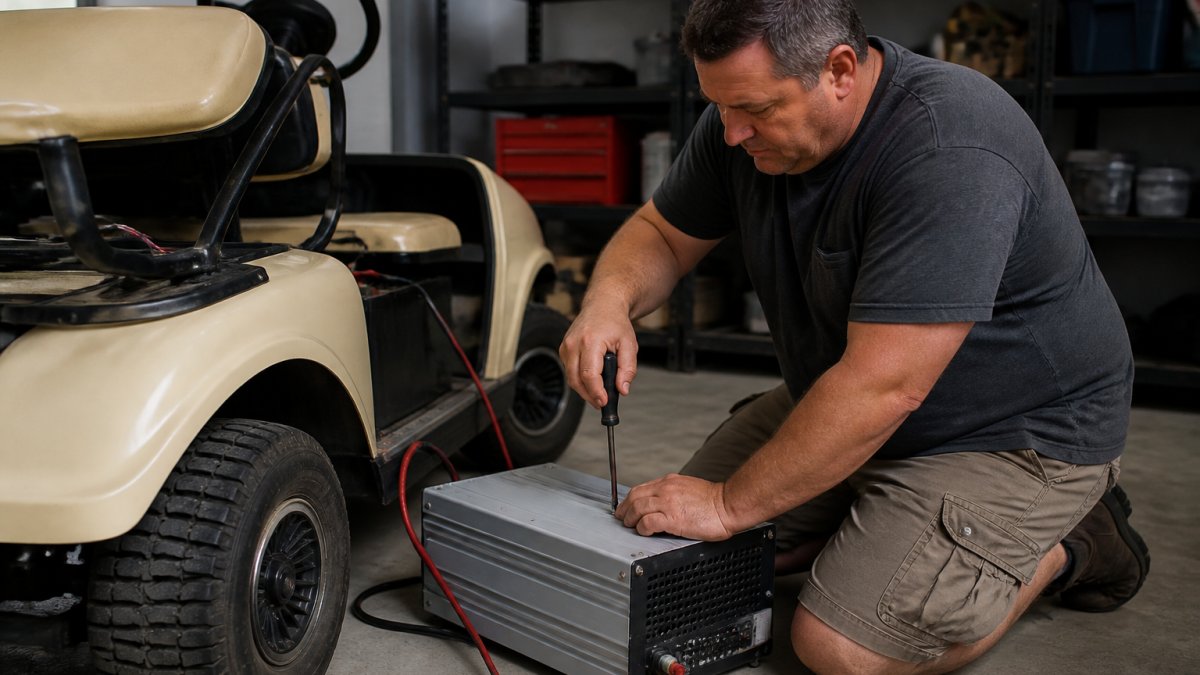
You can rule out the most common, cheapest-to-fix problems yourself before paying a diagnostic fee. Here's the sequence, simplest to most involved:
- Verify the power source. Plug a lamp into the same outlet. Check the breaker. Confirm the charger is actually receiving power.
- Inspect the charging cable and connector. Look for cuts, scorched pins, or a loose plug. A damaged cord is one of the most common causes of a charger that won't work.
- Check the fuse. Many chargers have an inline or accessible fuse. A blown fuse is a low-cost fix and an easy thing to rule out.
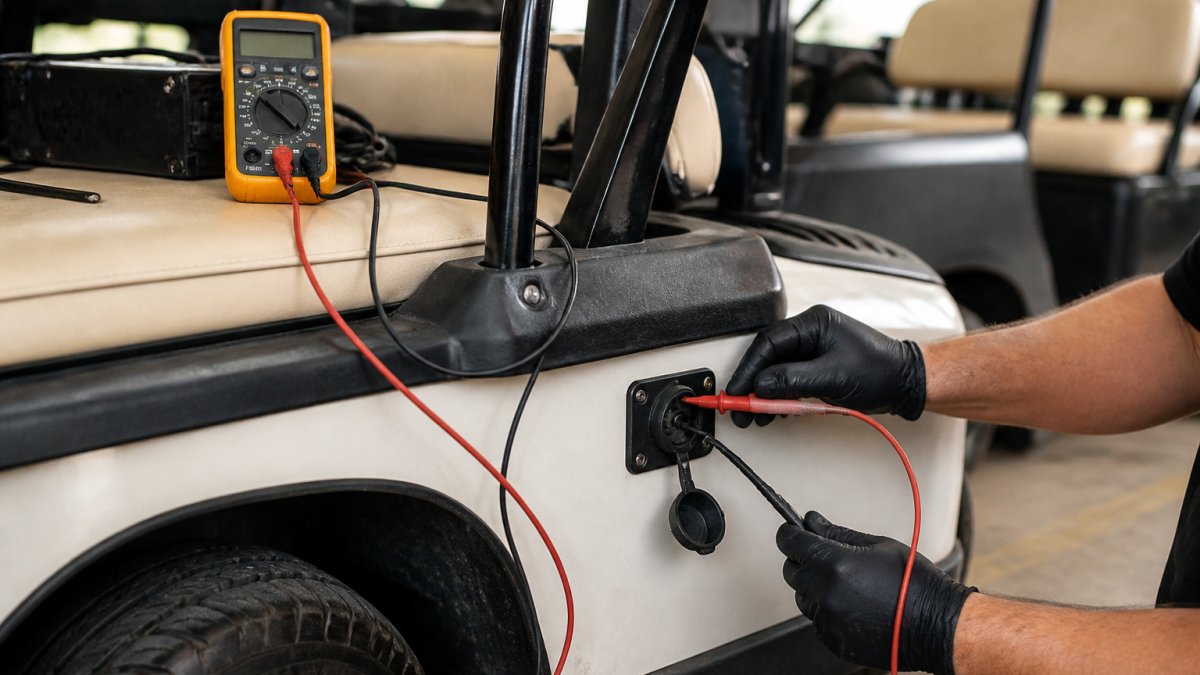
- Test the battery pack voltage. Use a multimeter to check pack voltage. If the pack is far below its rated voltage, the charger may refuse to start, and the problem is the batteries, not the charger.
- Test the charger output. With the charger connected, measure voltage at the output. No output with confirmed input power points to an internal fault.
If the charger still won't charge after these steps, the problem is in the charger internals or the battery pack. That's where a professional diagnosis saves money, guessing at internal parts gets expensive fast.
Golf Cart Charger Replacement Cost: New, Refurbished, and Used
When repair isn't the answer, replacement cost depends on whether the charger is onboard or portable, smart or basic, and new, refurbished, or used. New is priciest but comes with a warranty; refurbished sits in the middle with limited coverage; used is cheapest but riskiest, especially if you can't verify the model and voltage match.
Before buying, confirm compatibility: the charger must match your cart's voltage (36 or 48 volt is common) and charging profile. A lead-acid charger won't properly charge a lithium pack, and vice versa.
| Option | Upfront Cost | Warranty | Best For |
|---|---|---|---|
| New charger | Highest | Yes | Long-term reliability |
| Refurbished | Middle | Limited | Budget with some protection |
| Used | Lowest | Usually none | Short-term or backup use |
Repair or Replace? A Decision Framework for Your Charger
Use this framework to decide whether to repair or replace, the same logic we walk customers through at the counter.
- Repair if: the fault is a cord, fuse, connector, fan, or relay, and the charger is otherwise in good condition.
- Repair if: the charger is a quality unit that matches your cart and the repair cost is well below replacement cost.
- Replace if: the transformer or onboard module has failed and the part cost approaches the price of a new unit.
- Replace if: the charger is old, mismatched to your cart, or has already been repaired more than once.
One more factor: timeline. If you want to know why golf cart repairs take long, we break down the causes and typical timelines. If a repair means waiting weeks for a part, replacement can get you back on the road faster.
Golf Cart Battery Replacement Cost and How It Affects Charger Decisions
Battery health and charger health are tangled together, and separating them is the key to spending wisely: a charger that seems broken may be fine, and a pack that seems dead may just be undercharged by a failing charger.
Lead-acid battery replacement is a significant expense and often the real reason a cart "won't charge." Our golf cart battery replacement cost breakdown lays out the full picture.
Lithium conversions add another wrinkle. A lithium pack needs a charger with a matching charging profile and a battery management system that communicates properly.
What to Ignore When Shopping for Charger Repair and Replacements
Plenty of charger advice online is noise. Skip these:
- "Just buy a universal charger." Voltage and charging profile must match your cart. A universal charger that doesn't match can undercharge or damage your pack.
- "Any shop can fix it." Charger internals vary by brand and model. A shop that works on your model regularly diagnoses faster and sources parts more reliably.
- "Used is always fine." Used chargers can be a good deal, but only if you can verify the model, voltage, and condition. Skip listings you can't inspect.
- "Repair is always cheaper." Not when the failed part is expensive. Run the repair-versus-replace math before committing.
Get Your Charger Diagnosed and Repaired by Amplify Your Ride
Bringing your charger to a shop that works on golf carts daily shortens the guesswork. We stock and service the brands we sell, so parts and compatibility questions get answered on the spot. If you'd rather not wait weeks, book a golf cart repair and get your charger diagnosed and back on the cart.
Frequently Asked Questions
How much does it cost to repair a golf cart battery charger?
Repair costs depend on the fault. A damaged charging cable or connector is often the cheapest fix, while a failed circuit board or transformer pushes the bill higher. Diagnostic fees typically run separately and may be credited toward the repair if you proceed. Because pricing varies by charger brand, fault type, and local labor rates, ask for an itemized quote before authorizing work.
Is it cheaper to repair or replace a golf cart charger?
Repair usually wins when the fault is a cable, connector, or fuse and the charger is otherwise in good condition. Replacement makes more sense when the circuit board or transformer has failed, when parts are hard to source, or when the charger is old enough that a second failure is likely. Get both numbers before deciding.
How do I test if my golf cart battery charger is working?
Start with the battery pack: use a multimeter to record voltage before charging, then plug in the charger and check whether voltage climbs over the next hour. If the pack voltage rises, the charger is delivering current. If it stays flat, test the charger output at the plug and inspect the charging cable and connector for damage. A charger that powers on but never raises pack voltage usually has an internal fault. Professional electrical diagnostics can help confirm the cause.
Can a bad battery prevent the charger from working?
Yes. Many chargers will not start a charge cycle if the battery pack voltage is too low or a cell is failing, because the charger reads the pack as unsafe to charge. That can look like a dead charger when the real problem is the battery set. Test battery voltage first, then the charger. If your lead-acid set is near the end of its life, battery replacement cost may be the larger expense, and a lithium conversion is worth discussing with your dealer.
If your cart has been sitting on a dead charger for weeks, the fix may be simpler than you fear. Get started with Amplify Your Ride and get an honest diagnosis, a clear repair-or-replace recommendation, and your cart back on the road.