 Comparison
Golf Cart Controller Repair vs Replacement: Which to Choose
Last Updated: November 2, 2026
Quick Summary
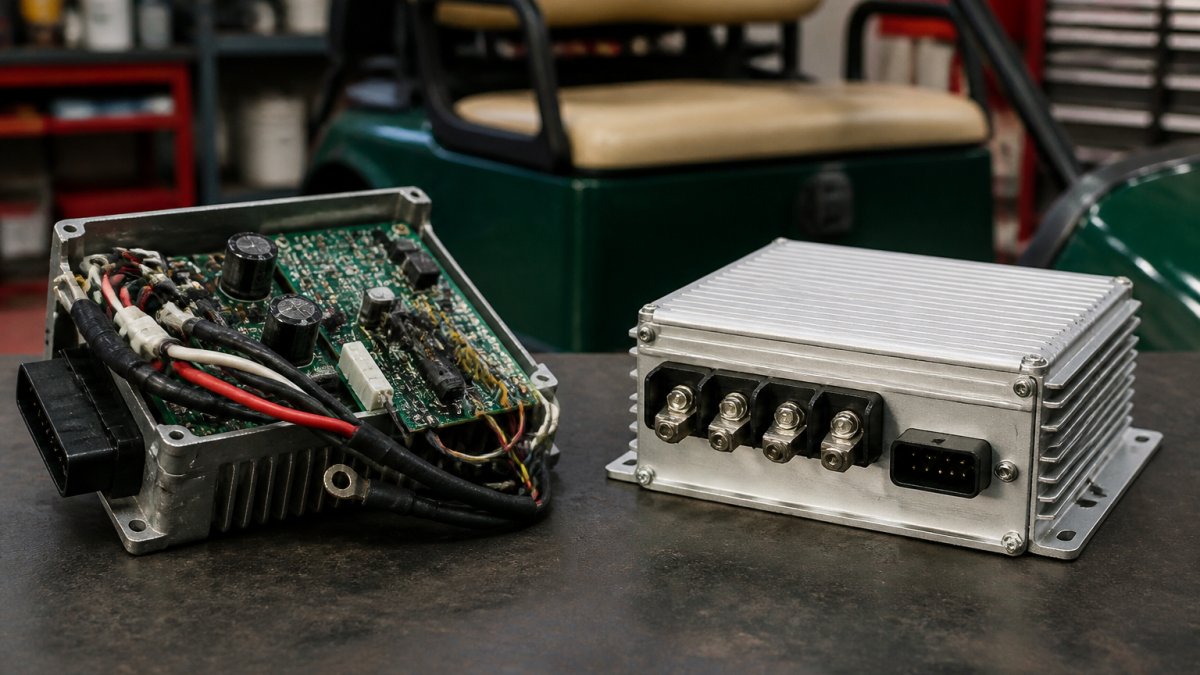
Repair the golf cart controller when the fault is a single repairable component and the rest of the electrical system is sound; replace it when the board is heat-damaged, the unit is obsolete, or you want a programmed controller with known service life. Always diagnose first, because weak batteries and corroded connections often imitate controller failure.
- Check battery condition under load and tighten high-current connections before condemning a controller.
- A repair only makes sense if the board itself is healthy and the root cause is corrected.
- Confirm controller type, system voltage, motor type, and current rating before buying a replacement.
- Ask whether a repair quote includes thermal reassembly, bench testing, and a credited diagnostic fee.
- Photograph the original controller's wiring and terminal layout before removal.
Table of Contents
- Repair vs Replacement at a Glance
- Golf Cart Controller Symptoms That Point to Failure
- How to Test a Golf Cart Controller Before You Condemn It
- What Controller Repair Actually Involves
- Golf Cart Controller Replacement Cost and Repair Cost Compared
- Golf Cart Replacement Controller Compatibility Checklist
- Warranty, Refurbished Units, and Repair Guarantees
- Book a Controller Diagnosis at Amplify Your Ride
- Frequently Asked Questions
Repair vs Replacement at a Glance
When a golf cart controller fails, the fastest path back to reliable driving starts with a proper diagnosis, not a parts order. At Amplify Your Ride, we see this go wrong both ways: owners replacing a healthy controller over a loose connection, and owners repairing a board that has already cooked itself twice.
The short answer: repair the golf cart controller when the fault is a single repairable component and the rest of the electrical system is sound; replace it when the board is heat-damaged, the unit is obsolete, or you want a programmed controller with known service life. Everything below explains how to tell the difference before you spend money.
| Situation | Better Choice | Why |
|---|---|---|
| One failed power transistor (FET) on an otherwise clean board | Repair | Cheapest path; keeps the original programmed controller |
| Controller runs hot, heat sink discolored, repeated failures | Replacement | Underlying heat or load problem will kill a repair too |
| Obsolete controller with no parts or programming support | Replacement | Long-term reliability matters more than the repair quote |
| Weak batteries or corroded connections causing symptoms | Neither yet | Fix the root cause first, then retest |
| Cart under warranty or with a service agreement | Check coverage first | Authorization rules may decide the outcome for you |
Golf Cart Controller Symptoms That Point to Failure
A failing golf cart controller rarely dies quietly. It usually announces itself through driving behavior first, and the pattern of those symptoms tells you a lot about whether the fault sits inside the controller or somewhere else in the system.
Reduced Speed, Loss of Power, and Click-But-No-Go
Three symptom families cover most controller complaints we diagnose:
- Reduced speed or loss of power under load. The cart moves but tops out below its normal maximum speed, or sags on inclines. This often traces to a controller limiting current because of heat, low battery voltage, or a failing FET.
- Click but no go. You hear the solenoid click and nothing happens. This is the classic no-response symptom and the most misdiagnosed; a weak battery pack or a bad connection at the controller terminals produces the same click with no movement.
- Intermittent cutouts. The cart runs, stops, then runs again after cooling, pointing toward thermal shutdown inside the controller or a heat sink that cannot shed heat.
Before condemning anything, check battery condition under load and inspect every electrical connection between the pack, solenoid, and motor controller. Weak batteries masquerade as controller failure constantly.
How to Test a Golf Cart Controller Before You Condemn It
Diagnosis comes before replacement, every time. A controller is expensive, and the faults that imitate controller failure are cheap to fix.
Start with the basics, in this order:
- Measure pack voltage at rest and under load. A pack that collapses under acceleration causes reduced speed and cutouts without any controller fault.
- Inspect and tighten all high-current connections. Look for heat discoloration at the controller terminals.
- Test the solenoid and throttle signal. No throttle input reaching the controller produces the same no-response symptom as a dead unit.
- Check for controller fault codes if your cart's controller supports them.
- Confirm motor condition. A shorted or worn motor can take a controller down with it.
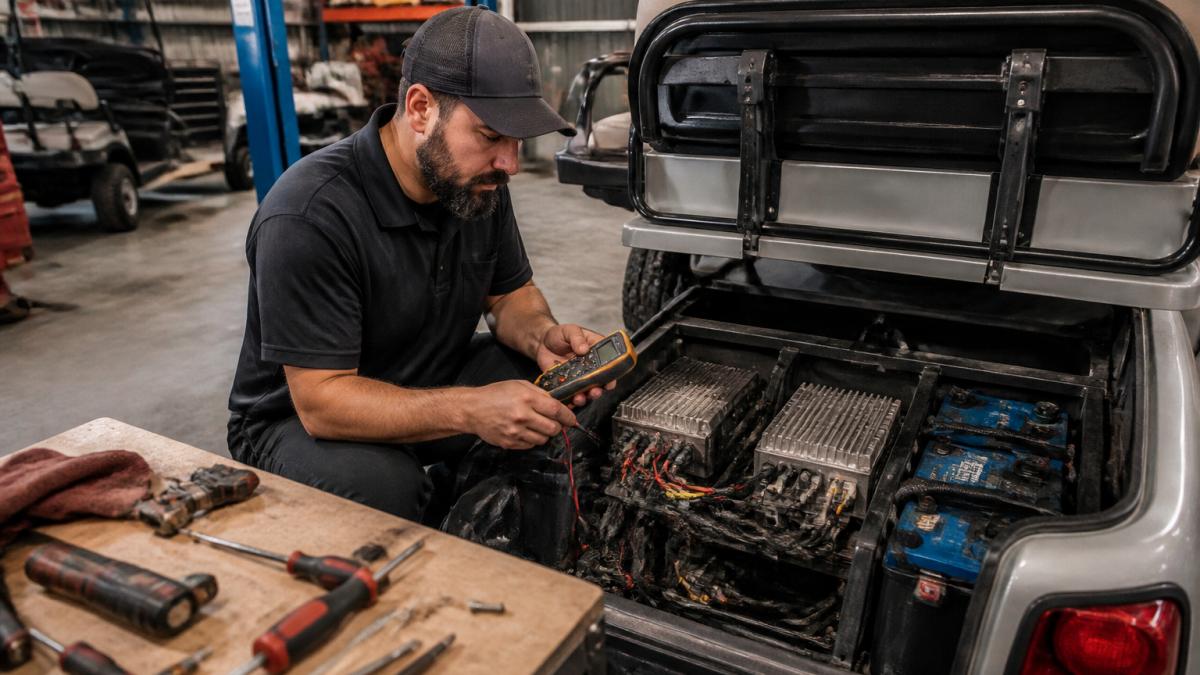
Watch out: skipping the battery and connection checks is the most common way owners pay for a replacement controller they never needed. If you want a professional diagnosis instead of working through this yourself, you can review the professional golf cart diagnostics service we offer.
What Controller Repair Actually Involves
Controller repair means replacing failed components on the circuit board, most often power transistors (FETs), and restoring the unit to working condition. It is real repair work, not a reset or a cleaning.
A typical repair bench process looks like this:
- Open the controller and inspect the circuit board for burn marks, cracked solder joints, and heat damage around the FETs and heat sink.
- Test the power transistors individually and replace failed ones.
- Check capacitors and the board's low-voltage section.
What most guides miss: a repair only makes sense if the board itself is healthy. If the controller failed because the motor drew too much current or the heat sink was blocked, the repaired unit will fail the same way.
Golf Cart Controller Replacement Cost and Repair Cost Compared
Replacement cost and repair cost pull in opposite directions: repair has the lower parts bill, replacement has the more predictable outcome. Most comparisons stop at "repair is cheaper" without showing what is inside each number. This section breaks down the line items to expect on a quote so you can compare two offers on equal terms.
What a Controller Repair Quote Should Itemize
A repair quote is not one number. Ask for these lines separately:
- Diagnostic or bench fee. Charged to identify the failed component. Ask whether it is credited toward the repair if you authorize the work.
- Parts. Power transistors (FETs), capacitors, and any board-level components replaced. Ask for the part list, not just a total.
- Labor. Bench time for desoldering, replacement, and reassembly, usually the largest line on a repair quote because it is skilled handwork.
What a Replacement Quote Should Itemize
- Controller unit. New, refurbished, or remanufactured, the quote should say which, because price and warranty differ substantially.
- Programming or configuration. Some replacement controllers arrive pre-programmed; others require dealer programming, a separate charge and scheduling step.
- Removal and installation labor. Pulling the old unit, transferring mounting hardware, and reconnecting high-current and signal wiring.
How to Compare the Two Quotes Fairly
Put both quotes on the same basis before deciding:
- Add the diagnostic fee to the repair total if it is not credited, and add programming to the replacement total if required. Sticker prices are rarely the real prices.
- Compare warranty length, not just warranty existence. A repair guaranteed for a short window and a replacement warranted longer are not equivalent even at the same price.
- Compare expected service life, not just first cost. A repair that returns a controller to service for years is a different value than one that buys months.
- Price the root cause. If the controller failed because of a dragging brake, a blocked heat sink, or a failing motor, that repair belongs in both columns. A replacement installed into an uncorrected fault will fail again, and the second failure is not covered by anyone's warranty.
Because pricing varies that much by cart model, controller type, and programming requirements, we quote each job after diagnosis rather than publishing a flat figure. If you are weighing the wider ownership picture, our complete breakdown of golf cart maintenance costs covers what routine care and repairs typically involve. Owners deciding between the two should also factor in how long each option keeps the cart out of service, which we explain in our guide to why golf cart repairs take long.
Golf Cart Replacement Controller Compatibility Checklist
A replacement controller must match the cart's electrical architecture, not just its shape. Buying the wrong unit is the second most expensive mistake in this process, right behind skipping diagnosis. The checklist below adds the verification step and failure mode for each item.
Matching Controller Type, Voltage, and Motor
- Controller type (sepex vs. series). Separately excited and series controllers are not interchangeable. Verify against the cart's model and the original controller's part number, not a photo. A mismatch typically produces a cart that will not run or runs only in one direction.
- System voltage. Confirm the pack voltage, 36-volt, 48-volt, and 72-volt systems are common, matches the replacement controller's rating. An under-rated controller may run briefly and then fail under load.
- Motor type (AC vs. DC). AC and DC carts use different controllers and wiring. Confirm from the motor nameplate or the cart's service documentation.
Verifying a Used, Refurbished, or Remanufactured Unit
Before installing any controller that is not new, confirm:
- Part number match. The unit's part number should match the original or a documented supersession. "Looks the same" is not a match.
- Test documentation. Ask for bench-test results or a test certificate. A refurbished unit without test documentation is a gamble, not a bargain.
- Return window. Confirm it in writing before installation. Once the controller is installed and powered up, most sellers treat it as used.
Pre-Installation Checks That Prevent Repeat Failures
Compatibility is necessary but not sufficient. Before powering a new controller, verify the conditions that killed the old one:
- Battery pack condition under load. A pack that collapses under acceleration will stress a new controller the same way it stressed the old one.
- High-current connections. Inspect and tighten every connection between the pack, solenoid, controller, and motor. Look for heat discoloration at the terminals.
- Heat-sink airflow. Clear debris and confirm the mounting location allows airflow. A blocked heat sink is a common cause of repeat controller failure.
Upgrade options exist beyond stock controllers. Brands like Navitas, Alltrax, and Curtis appear in owner comparisons of programmable controllers for 48-volt carts, and the controller comparison from Canyon Lake Mobile lays out how those options differ on torque and programmability. Upgrades can improve performance, but only after compatibility is confirmed.
Warranty, Refurbished Units, and Repair Guarantees
Warranty terms decide more outcomes than most owners expect. Ask three questions before authorizing either path: what does the warranty cover, how long does it run, and who honors it?
Refurbished controllers sit in the middle ground. A properly tested unit with a clear guarantee can be sensible for an older cart where a new controller costs more than the cart justifies.
On the repair side, ask whether the shop guarantees the repair itself and for how long, and whether a failed repair can be credited toward a replacement. Protecting a repaired or replaced controller long term comes down to maintenance, and our golf cart maintenance checklist for owners covers the checks that prevent repeat failures.
Book a Controller Diagnosis at Amplify Your Ride
The hardest part of this decision is not the repair itself. It is knowing which fault you actually have before money changes hands, exactly where a proper diagnosis saves the most.
At Amplify Your Ride, we diagnose controller faults before recommending either path, so you are not paying for a replacement when a connection or a battery pack is the real problem. If you would rather skip the bench work and get back to driving, you can find fast golf cart repair service and let our team handle the diagnosis and install.
Frequently Asked Questions
Can a golf cart controller be repaired, or does it always need replacing?
Some controller failures are repairable. A technician can replace power transistors, FETs, or damaged circuit board components and re-seal the unit. Repairs make the most sense when the failure is isolated and the controller model is still supported. If the board is burned across multiple traces, the heat sink is damaged, or the unit is old and discontinued, replacement is usually the better call. Diagnosis first tells you which path applies.
How do I know if my golf cart controller is bad?
Common golf cart controller symptoms include reduced speed, loss of power under load, a click with no movement, or no response at all when you press the pedal. Before condemning the controller, check battery condition, electrical connections, the solenoid, and the throttle. Weak batteries and corroded terminals mimic controller failure often enough that a proper diagnosis is worth the time.
How much does golf cart controller replacement cost compared with repair?
Golf cart controller replacement cost depends on the controller type, voltage, and whether the unit is new or refurbished, so pricing varies by cart. Repair is generally less expensive when only a few components have failed, but it only makes sense if the board is otherwise sound. Ask for an itemized quote covering parts and labor on both options before you decide.
Will a replacement controller work with my golf cart motor?
Only if golf cart replacement controller compatibility is confirmed first. Match the controller type, system voltage, and motor type, since an AC motor and a 48-volt system need a controller built for them. A programmed controller also has to be set up for your cart. Check the model-specific fit before buying, or have a dealer verify the match.
Can I replace a golf cart controller myself?
It is possible on some carts, but the risks are real. Controllers handle high current, so disconnect the battery pack and follow safety precautions before touching wiring. The bigger issue is diagnosis: installing a new controller on a cart with a wiring fault can destroy the replacement. If you are unsure how to test a golf cart controller, have a technician diagnose it first.
A cart that clicks but will not move, or one that keeps cutting out on the same hill, deserves a real diagnosis rather than a guess. Bring it to Amplify Your Ride and we will test the controller, the batteries, and the connections, then tell you plainly whether repair or replacement is the better spend. Get started with Amplify Your Ride and get your cart diagnosed, repaired, and back on the road.