 listicle
Professional Golf Cart Diagnostics Service: 2026 Review
Table of Contents
- What a Professional Golf Cart Diagnostics Service Actually Does
- Diagnostic Tool Breakdown: What Shops Use and Why It Matters
- Battery Testing and Electrical System Diagnostics
- Motor, Controller, and Drivetrain Troubleshooting
- How to Fix Golf Cart Steering and Other Mechanical Issues
- Mobile Golf Cart Repair Cost: What Drives the Price
- Your Golf Cart Maintenance Checklist: Preventing Costly Breakdowns
- DIY vs. Professional Diagnostics: Where to Draw the Line
- Frequently Asked Questions
Last Updated: October 2, 2026
What a Professional Golf Cart Diagnostics Service Actually Does
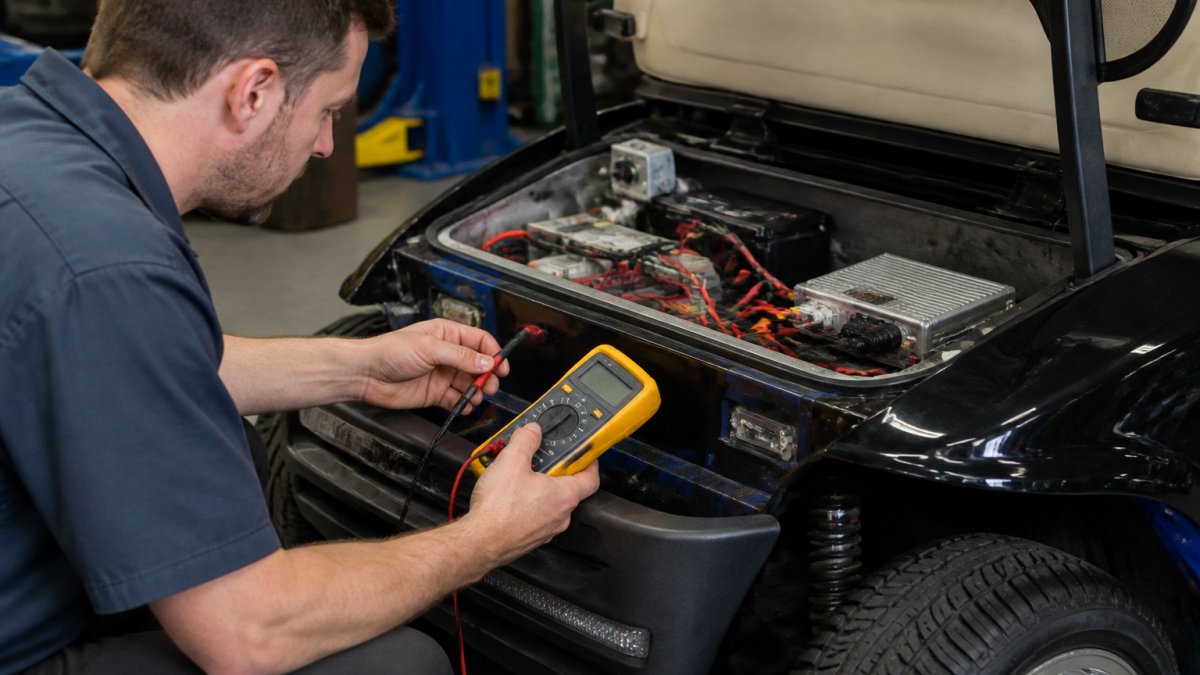
A professional golf cart diagnostics service is a systematic process where trained technicians test a cart's battery, electrical, motor, and mechanical systems to find the exact cause of a problem before any parts are replaced. At Amplify Your Ride, we've watched too many owners pay for guesswork repairs. A proper session follows a fixed order: pull fault codes, measure voltage, test components under load, then confirm the repair.
The goal: know what's wrong, what it costs, and whether the fix is worth it before a wrench touches your cart.
The Core Diagnostic Process: From Fault Codes to Voltage Drop
Technicians start with a complaint, not a parts list. A cart that "won't move" could be a dead battery, a stuck solenoid, or a failed controller. Each has a different price tag.
The process moves through four stages:
- Fault code scan on carts with electronic controllers
- Voltage drop testing across the battery pack and cables
- Component isolation, testing the solenoid, throttle sensor, and motor separately
- Road test under real load to confirm the fix
The U.S. Department of Energy guide to battery electric vehicle testing explains why load testing matters more than a simple voltage reading. A battery can show full voltage at rest and collapse the moment you press the pedal.
Diagnostic Tool Breakdown: What Shops Use and Why It Matters
The tools a shop owns tell you how deep their diagnostics go. Hand tools and a test light can find a broken wire, but not an intermittent controller fault.
Here is what separates a real diagnostic setup from a basic repair bench:
| Tool | What It Finds | Why It Matters |
|---|---|---|
| Digital multimeter | Voltage drop, continuity, charging output | Catches weak cables and failing batteries |
| Load tester | Battery health under real draw | Exposes batteries that pass a static test |
| Controller programmer | Fault codes, throttle curves | Reads stored errors on modern carts |
| Clamp meter | Current draw, motor amps | Spots a dragging motor or brake |
| Insulation tester | Shorted motor windings | Prevents repeat controller failures |
A shop with only the first two tools handles basic electrical troubleshooting; the last three are what you pay a dealership for. If a shop cannot read fault codes on your cart's controller, they are guessing on anything electronic.
Battery Testing and Electrical System Diagnostics
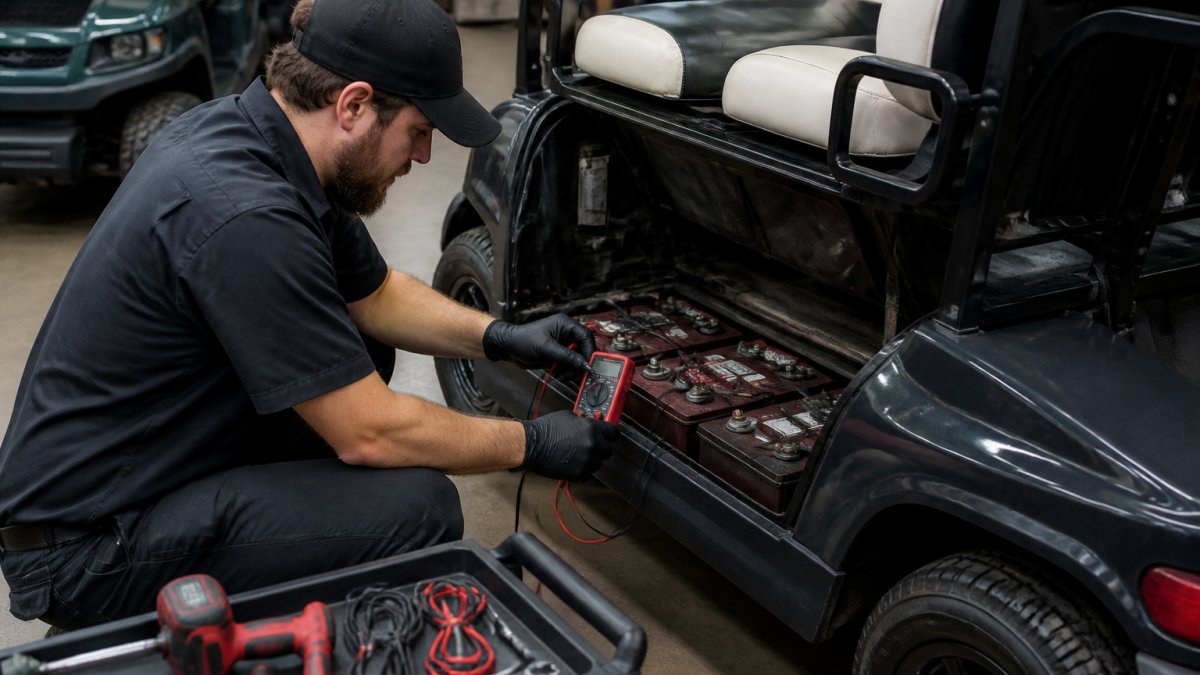
Battery testing is where most golf cart diagnostics start, because battery problems mimic almost every other fault. A weak pack causes slow acceleration, short range, and random shutdowns. Owners often replace a controller when the real problem is one bad cell.
Testing Battery Health Under Load
A static voltage reading tells you almost nothing. A 48-volt pack can read full charge and still fail under load.
Technicians test each battery individually, then the pack as a whole while the cart is moving.
What matters is consistency: if one battery reads notably lower than its neighbors under load, it is failing even if it looks fine at rest.
Starter-Generator and Charging System Checks
Gas carts have their own diagnostic path. The starter-generator handles both starting and charging, so one worn unit causes hard starting and a dead battery at once.
Technicians check charging output at the battery while the engine runs, inspect the wiring harness for corrosion, and test the voltage regulator. On electric carts, an onboard charger that shuts off early leaves the pack chronically undercharged, shortening battery life.
Motor, Controller, and Drivetrain Troubleshooting
Motor and controller problems show up as jerking, loss of speed, or a cart that runs in one direction only.
Drivetrain inspection covers the rear axle, differential, and brakes. A dragging brake feels like a weak motor. Adjusting the brake is far cheaper than replacing a motor, and a good diagnostic catches the difference.
How to Fix Golf Cart Steering and Other Mechanical Issues
Learning how to fix golf cart steering starts with knowing which parts actually control it, and when a "steering" complaint is really an electrical or drivetrain fault in disguise. That distinction is where professional diagnostics earn their fee.
Most steering problems trace back to a handful of components, and the fix is often an adjustment rather than a replacement.
Common steering complaints and their usual causes:
- Play in the wheel: worn tie rod ends or a loose steering box
- Pulling to one side: uneven tire pressure or a bent tie rod
- Stiff steering: dry steering column bearings or a failing rack
- Vibration: worn kingpin bushings or unbalanced tires
- Wandering at speed: worn kingpin bushings, loose wheel bearings, or misaligned toe
Tire pressure is the first thing to check. It costs nothing and solves a surprising number of "steering" complaints. If pressure is correct and the problem remains, the cart needs a front-end inspection on a lift, where a technician can check tie rod ends, kingpin bushings, and wheel bearings for play.
When a Steering Complaint Isn't Steering
Several faults that feel like steering problems originate elsewhere:
- A dragging brake on one side pulls the cart the same way a bent tie rod does. The fix is a brake adjustment, not a front-end rebuild.
- A failing motor or controller can cause torque steer, the cart pulls under acceleration but tracks straight when coasting. That pattern points to the drivetrain, not the steering.
- Uneven tire wear from a worn suspension bushing mimics an alignment problem. Aligning a cart with a worn bushing just wears the new tires unevenly.
- A loose or corroded battery cable can cause intermittent power delivery that the driver feels as a lurch or pull.
A technician separates these by testing under load and on a lift, not by guessing from the driver's description, the reported symptom and the failing system are often two different things.
Brake Adjustment and the Drag Test
Brake adjustment follows the same diagnostic logic. A brake that grabs or drags is usually out of adjustment, not worn out. Technicians adjust cable tension and check the drum or disc before quoting a replacement.
The confirming test is a drag test: raise the cart, spin each wheel by hand, and feel for resistance.
Drivetrain and Rear Axle Checks
Rear axle and differential problems show up as noise, vibration, or a cart that feels like it's fighting itself. Technicians check gear oil level and condition, inspect axle bearings for play, and listen for whine under load. A differential low on oil will howl before it fails, catching it at the howl stage is far cheaper than at the failure stage.
Why Brand Familiarity Shortens the Diagnostic
Steering and suspension layouts differ between manufacturers, tie rod geometry, kingpin design, and brake hardware are not interchangeable across brands. A technician who works on your cart's brand regularly knows which components wear first and which adjustments are within spec, turning a two-hour diagnostic into a thirty-minute confirmation and preventing the most common mistake in mechanical repair: replacing a part that was never the problem.
Mobile Golf Cart Repair Cost: What Drives the Price
Mobile golf cart repair cost breaks into four line items, and a shop that won't separate them is hiding something. Ask for each before you book.
| Line Item | What It Covers | How It's Usually Charged |
|---|---|---|
| Diagnostic fee | Time to test the cart and identify the fault | Flat fee per visit, often credited toward the repair |
| Travel charge | Technician's drive to your location | Flat zone fee or per-mile beyond a base radius |
| Labor | Time to perform the confirmed repair | Hourly, with a published minimum |
| Parts | Replacement components | At list price, OEM or aftermarket |
Most mobile providers charge the diagnostic fee and travel charge up front, then quote labor and parts once the fault is confirmed. That structure protects you: you pay for the diagnosis, see the repair quote, and decide whether to proceed.
Why the Diagnostic Fee Exists
The diagnostic fee is not a penalty. It pays for the technician's time, calibrated test equipment, and the liability of putting a written diagnosis in your hands.
A common pattern is a flat diagnostic fee covering a set testing window, often one to two hours on site. If the fault isn't found in that window, the shop should tell you before the meter keeps running.
Travel Charges and Service Radius
Travel charges scale with distance from the shop. A provider twenty minutes away may include travel in the diagnostic fee; one an hour out will not. Ask whether the charge is flat by zone or per mile, and whether a return visit for parts carries a second travel charge, that second-visit charge is the one owners forget to ask about and the one that stings.
When Mobile Service Costs More Than a Shop Visit
Mobile service saves you the cost and hassle of transporting a cart, a trailer rental, a truck, or a paid tow. For a cart that won't move, that transport cost alone can exceed the mobile travel charge. But mobile service has real limits:
- No lift. Brake, axle, and suspension work that needs the cart raised is slower or impossible on site.
- Limited tool set. A van carries the common diagnostic tools, not every specialty fixture.
- Weather and access. A cart parked on grass or behind a gate slows the job.
Intermittent electrical faults are the worst fit for mobile service. They often need a controlled environment, a full tool set, and repeated load runs. If your fault comes and goes, expect the shop to recommend bringing the cart in, treat that as a sign of honesty, not a bait-and-switch.
Reading a Repair Quote
A complete quote names the failed component, the test that confirmed it, the part number, the labor hours, and the warranty on both.
Pricing varies by market and cart type, so treat any figure as a starting point. Compare the structure, fee, travel, labor, parts, across shops, because that structure determines whether the final bill matches the quote.
Your Golf Cart Maintenance Checklist: Preventing Costly Breakdowns
A golf cart maintenance checklist prevents most of the breakdowns that lead to expensive diagnostics. The work is simple and takes under an hour when done on schedule.
- Check tire pressure and look for uneven wear
- Inspect battery terminals for corrosion and tighten connections
- Test battery voltage and note any drop from last month
- Check water levels on flooded lead-acid batteries
- Inspect the wiring harness for frayed or chewed wires
- Test brakes and adjust cable tension if needed
- Check the charging system output
- Lubricate steering and suspension points
- Look for fluid leaks under the cart
- Test lights, horn, and other accessories
Preventative maintenance catches small problems before they strand you. A corroded terminal costs minutes to clean. The same corrosion left alone can melt a cable and take the controller with it.
DIY vs. Professional Diagnostics: Where to Draw the Line
DIY diagnostics make sense for a defined set of problems; professional diagnostics make sense for everything else. Knowing the line saves you money.
Handle it yourself when:
- The cart won't start and you suspect a loose terminal or dead battery
- A tire is flat or a brake needs a simple adjustment
- You can see obvious physical damage, like a frayed cable
Call a professional when:
- The cart has an intermittent fault that comes and goes
- You've replaced a part and the problem returned
- The cart has a controller or motor issue
- You've already made one repair attempt that didn't work
That last point matters. Owners who try to fix a hesitation issue often make it worse by adjusting the wrong component.
Brand-specific nuances matter here too.
At Amplify Your Ride, we sell and service EPIC, Star EV, and Greyson carts, and we know how each brand behaves when something fails.
Frequently Asked Questions
How much does a professional golf cart diagnostic cost?
Diagnostic fees vary by provider and service model. Some shops charge a flat fee that includes up to two hours of testing, while mobile services may charge a base rate plus a travel fee. A bundled annual service program that includes diagnostics, maintenance, and pickup and delivery may cost around $299. Always ask what the diagnostic fee covers and whether it is applied to the repair cost if you proceed.
What is included in a standard golf cart diagnostic service?
A thorough diagnostic typically covers battery testing under load, electrical system checks including the wiring harness and solenoid, controller fault code scanning, motor performance evaluation, and a visual inspection of the drivetrain and brakes. Some providers also check the charging system and starter-generator on gas models. Ask for a written summary of findings so you understand exactly what was tested and what needs attention.
Is it worth paying for professional diagnostics versus DIY troubleshooting?
It depends on the symptom. Simple issues like a loose cable or corroded terminal are reasonable DIY checks. But intermittent electrical faults, controller error codes, and throttle sensor problems often require specialized diagnostic tools that most owners do not have. A professional diagnostic can prevent you from replacing parts that are not actually faulty, which often costs more than the diagnostic fee itself.
Can a golf cart be diagnosed remotely?
Remote diagnostics are limited for most golf carts because they lack the telematics systems found in modern cars. However, some mobile repair services bring diagnostic equipment directly to your location, which is the next best thing. You can also describe symptoms over the phone to help a shop prepare, but physical testing with a multimeter and controller scanner is still required for accurate results.
How often should I have my golf cart professionally inspected?
An annual professional inspection is a good baseline for most owners, especially before peak season. If you use your cart daily for transportation, consider a check every six months. A routine maintenance visit typically includes brake adjustment, battery health testing, tire condition, and a review of electrical connections. Catching small issues early prevents them from becoming expensive repairs later.
Golf cart problems rarely fix themselves, and the longer you wait, the more expensive the repair becomes. Amplify Your Ride offers professional golf cart diagnostics, OEM parts, and service for new and used carts, along with rentals and parts for the Chattahoochee Hills area. Get started with Amplify Your Ride and find out exactly what's wrong with your cart before you spend another dollar on guesswork.