 How-to
How Do You Choose the Right Golf Cart Size?
Last Updated: November 10, 2026
Quick Summary
To choose the right golf cart size, count the people who will actually ride with you, then pick the smallest golf cart size that fits them. Seat count drives every other dimension, so decide between two, four, or six seats before you measure length, width, and roof height.
- A two-passenger cart suits solo drivers and couples, while a four-passenger cart fits a family or two couples.
- Typical two-passenger carts run 92-110 inches long, 47-50 inches wide, and 68-75 inches tall.
- A rear-facing seat adds 18-24 inches of length, and a lift kit raises roof height by 4-8 inches.
- Leave cart length plus 24 inches in front and behind for walking and charging cord access.
- Most two-passenger carts turn in 8-10 feet, while four-passenger carts need 10-14 feet.
Table of Contents
- Start With Passenger Capacity, Then Work Backward
- Two, Four, or Six Seats: Who Actually Rides With You?
- Standard Golf Cart Dimensions You Can Measure Against
- Measure Your Garage, Shed, and Door Before You Buy
- 2 vs 4 Passenger Golf Cart Pros and Cons
- Turning Radius, Path Width, and Maneuverability on Your Property
- Payload Capacity, Cargo, and Custom Golf Cart Accessories for Sale
- Match Your Cart Size to How You'll Actually Use It
- Bring Your Measurements to a Cart Fit Consultation
- Frequently Asked Questions
Start With Passenger Capacity, Then Work Backward
The fastest way to learn how to choose the right golf cart size is to count the people who will actually ride with you, then pick the smallest golf cart size that fits them. Most buyers start with length and width. That is backward. Seat count drives every other dimension, so it comes first.
A cart that seats two people comfortably beats a six-seater that will not clear your garage door.
So here is the rule: seats first, measurements second, accessories last.
Two, Four, or Six Seats: Who Actually Rides With You?
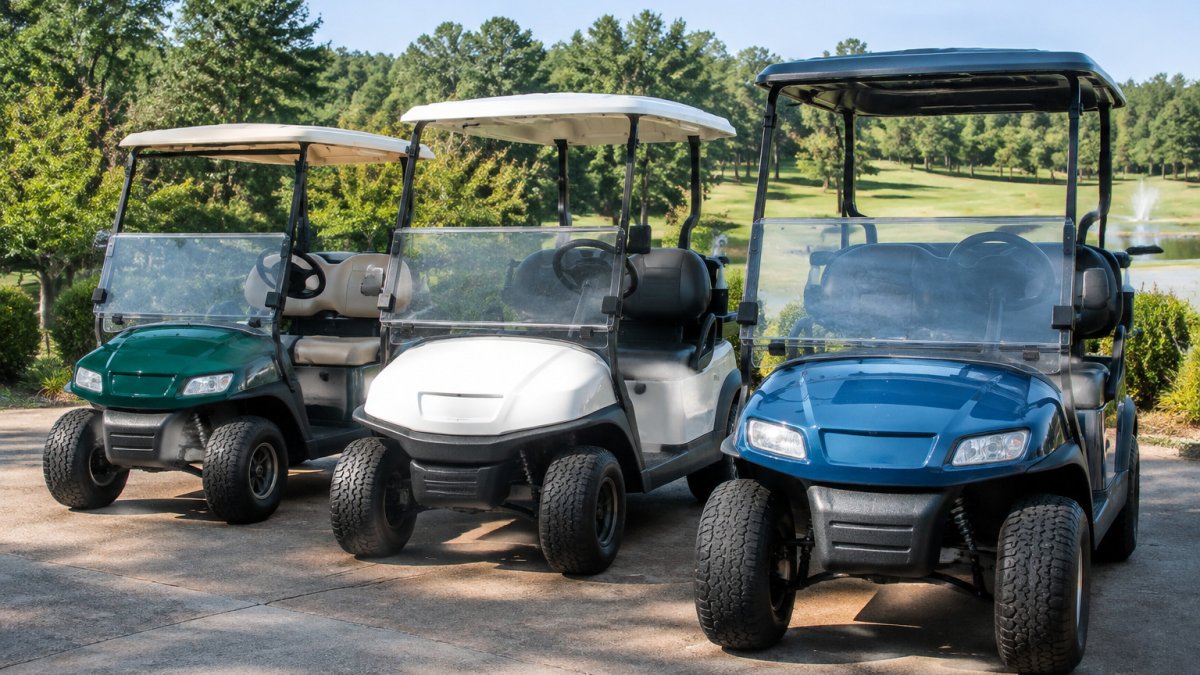
A two-passenger cart suits solo drivers and couples. A four-passenger cart fits a family or two couples. A six-passenger cart works for groups, rentals, and event shuttles.
Be honest about the daily headcount, not the holiday headcount. If four people ride twice a year, a two-seat cart plus a second trip beats a six-seater blocking your path all year.
Ask three questions:
- Who rides on a normal Tuesday?
- Who rides on a weekend?
- Who rides only when guests visit?
Most households land on four seats. Neighborhood use with kids pushes toward four or six. Utility use with tools and cargo often works fine with two.
Standard Golf Cart Dimensions You Can Measure Against
Standard golf cart dimensions vary by seat count, and the gap is bigger than most buyers expect. A two-passenger cart is the compact baseline. Each extra row of seats adds length, and often width and roof height too. The table below gives typical ranges you can hold a tape measure against, not exact specs for any one model.
Length, Width, and Roof Height by Seat Count
| Configuration | Typical Length | Typical Width | Typical Roof Height |
|---|---|---|---|
| 2-passenger | 92-110 in | 47-50 in | 68-75 in |
| 4-passenger | 110-125 in | 48-55 in | 70-80 in |
| 6-passenger | 125-145 in | 55-60 in | 75-85 in |
Typical Length
Treat these as ranges to measure against, not guarantees. Always confirm the numbers on the specific model you are considering, because frame design and bodywork vary by brand.
Two things surprise first-time buyers. First, a rear-facing seat adds length you did not plan for. Second, a lift kit or a roof raises overall height, which matters for doorways and trailers.
How Accessories Change the Footprint
Accessories can change the numbers you measured. Plan for them before you buy:
- Rear-facing seat: adds 18-24 inches of length and shifts weight rearward.
- Lift kit: raises roof height by 4-8 inches and raises the center of gravity, which changes handling on slopes.
- Windshield and roof: add height and can add width at the mirrors; a folding windshield still needs clearance when raised.
- Cargo bed or storage box: adds length at the rear and eats into payload capacity.
- Golf bag holder: adds 12-18 inches behind the rear seat on two-passenger carts.
Measure the cart as it will be configured, not as it sits on the showroom floor. A cart that fits bare may not fit with the rear seat and lift kit you plan to add.
Measure Your Garage, Shed, and Door Before You Buy
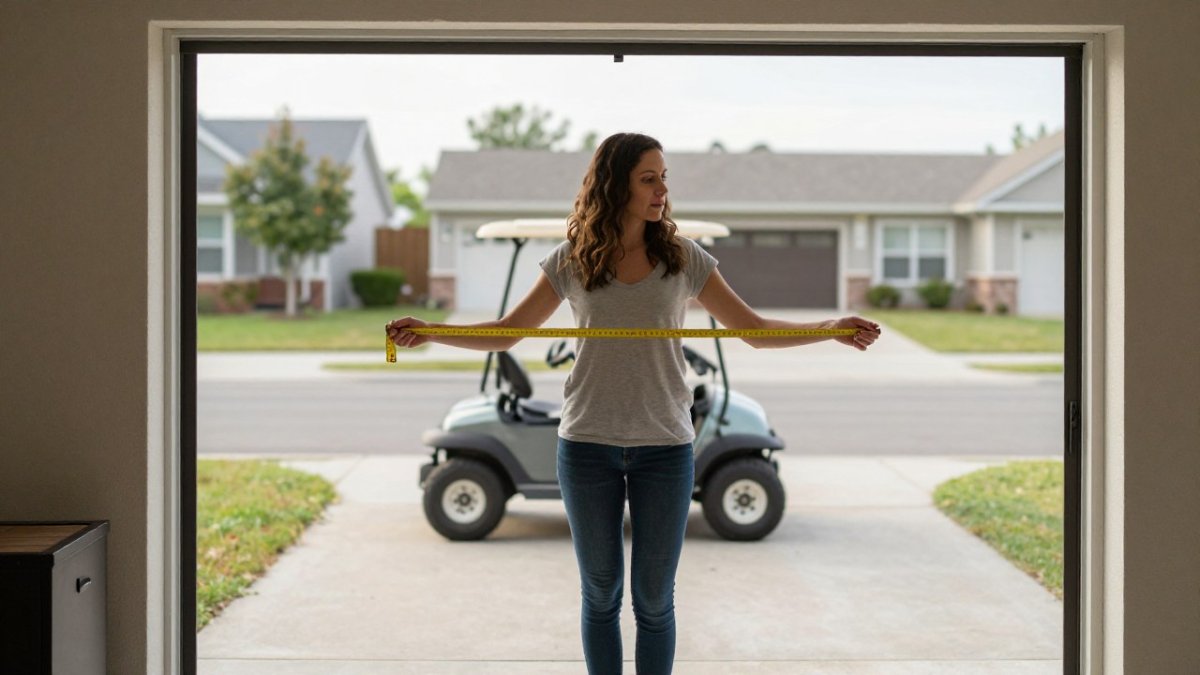
Measure the space before you fall in love with a cart. Grab a tape measure and record four numbers: garage depth, garage width, door width, and door height. Write them down. Guessing is how buyers end up with a cart that fits the driveway but not the shed.
A Clearance Worksheet for Storage and Doorways
Use this checklist and leave room to spare. The allowances below are practical minimums, not code requirements:
- Garage depth: cart length plus 24 inches in front and 24 inches behind for walking and charging cord access.
- Garage width: cart width plus 36 inches on the driver side for door swing and shelving.
- Door width: cart width plus 6 inches on each side (12 inches total) for steering error.
- Door height: roof height plus 4 inches for a lifted cart or tall roof; a standard 80-inch door clears most unlifted carts but not all lifted ones.
- Turning space: a clear circle at least twice the cart's turning radius; most two-passenger carts turn in 8-10 feet, four-passenger carts in 10-14 feet.
- Overhead clearance: check garage door tracks, light fixtures, and opener rails, not just the opening.
Watch out: a cart that clears the door by an inch will scrape it the first time someone turns while entering. Leave a real margin, not a technical one.
Turning Radius and Path Width
Turning radius is the space a cart needs to complete a U-turn, and it generally grows with length. Walk your property and measure the narrowest path between fences, trees, and planters. If that path is under 6 feet wide, a wider four- or six-passenger cart will feel tight every trip.
Also note tight corners near the garage or gate, slopes and uneven ground, and where you turn around at the end of a driveway. Longer carts need wider arcs, and lifted carts sit higher, which changes how you see the path edges. If your property has hills or narrow lanes, our guide to the best golf carts for hilly terrain covers carts built for slopes and tight turns.
2 vs 4 Passenger Golf Cart Pros and Cons
The 2 vs 4 passenger golf cart pros and cons come down to space versus company. Two-seaters are generally easier to store, park, and maneuver. Four-seaters carry more people but generally need more room.
Two-passenger pros: compact footprint, easier turning, simpler storage, lower weight. Two-passenger cons: no room for guests, limited cargo without accessories.
Four-passenger pros: room for family or friends, better for neighborhood use, more resale appeal. Four-passenger cons: longer body, tighter garage fit, more careful path planning.
If you are leaning toward four seats, it helps to see real models side by side. Our guide to the best 4-seater golf carts for sale breaks down actual configurations so you can compare before you commit.
Turning Radius, Path Width, and Maneuverability on Your Property
Maneuverability decides whether a cart feels effortless or annoying every single day. A cart that is too long for your paths turns a quick trip into a parking puzzle. Turning radius, path width, and terrain all matter here.
Walk your property and note:
- Path width between fences, trees, and planters
- Tight corners near the garage or gate
- Slopes and uneven ground
- Where you turn around at the end of a driveway
Longer carts generally need wider arcs. Lifted carts sit higher, which can change how you see the path edges. If your property has hills or narrow lanes, our guide to the best golf carts for hilly terrain covers carts built for slopes and tight turns.
Payload Capacity, Cargo, and Custom Golf Cart Accessories for Sale
Payload capacity is the total weight a cart is rated to carry, including passengers, cargo, and accessories. Add up your riders, your golf bags, and your gear before you pick a size. A cart that carries four people may have little capacity left for cargo.
Cargo and accessories change the fit:
- Golf bags add length at the rear
- Storage boxes and coolers eat into deck space
- Lift kits raise height and shift the center of gravity
- Heavy accessories count against payload
Plan accessories as part of the size decision, not an afterthought. If you want to see what is available, our custom golf cart accessories for sale buyer's guide covers the options and how they affect fit.
Match Your Cart Size to How You'll Actually Use It
Use case should settle the size debate. Neighborhood driving, golf course trips, utility work, and event shuttles each point to a different answer.
- Neighborhood use: four seats for family trips, two for couples
- Golf course: two seats plus bag storage
- Utility use: two seats with a cargo bed or heavy-duty rear
- Group or event use: six seats for shuttles and gatherings
Serenbe property owners often balance narrow paths with family needs, which makes four seats the common middle ground. Our guide for Serenbe property owners matches cart size to local paths and daily routines.
Bring Your Measurements to a Cart Fit Consultation
At Amplify Your Ride, we sell new EPIC, Star EV, and Greyson carts, plus used models. We also handle service, parts, and rentals, including a Horseless Carriage for weddings and events. To see what is on the lot first, browse our top models and brands for 2026 buyers and bring your list to the consultation.
Size mistakes are expensive and hard to undo once a cart is in your garage. Amplify Your Ride helps you avoid them with a fit consultation built around your measurements, your headcount, and your property. We carry new EPIC, Star EV, and Greyson carts, plus used inventory, and we back every sale with service and parts. Get started with Amplify Your Ride and drive home a cart that fits the first time.
Frequently Asked Questions
What are the standard dimensions for a residential golf cart?
Two-passenger carts are generally shorter and narrower than four- and six-passenger models, and dimensions vary by manufacturer. Add a lift kit and the roof height climbs several inches. Measure your actual storage space and compare it against the specific model's spec sheet rather than a generic number.
How much space do I need to store a golf cart?
Plan for clearance beyond the cart's length and enough room on the side you walk through. Larger carts generally need more floor space than smaller ones. Check door width too, since a 48-inch opening leaves little room to steer a 50-inch cart through without folding mirrors.
Does golf cart size affect battery life or performance?
Yes. Larger carts generally weigh more, which can affect range per charge and acceleration compared with smaller models. If your routes are short neighborhood trips, a smaller cart often delivers better range and easier handling for the same power setup.
How do I determine the right golf cart size for my property?
Count the people who ride most often, then measure your garage depth, door width, and the narrowest path on your property. Allow additional clearance beyond the cart's length and width. If you regularly carry four or more people, a four- or six-passenger cart makes sense, but confirm it fits your storage and turns comfortably on your paths before committing.