 How-to
How to Know If Golf Cart Insurance Covers Repairs
Last Updated: November 12, 2026
Quick Summary
Golf cart insurance covers repairs only if you carry collision or comprehensive coverage, which pay for crash damage, theft, vandalism, fire, hail, and falling objects. Liability and medical payments coverage never repair your cart, and standard policies exclude mechanical breakdowns and wear and tear.
- Collision coverage pays to fix your cart after a crash, even when you are at fault.
- Comprehensive coverage handles theft, vandalism, hail, wind, fire, flood, and falling objects.
- Standard golf cart insurance does not cover mechanical breakdowns, wear and tear, or routine maintenance.
- A $2,000 claim with a $500 deductible pays $1,500, so small claims rarely make sense.
- Insurers total a cart when repairs cost more than its actual cash value.
Table of Contents
- What Does Golf Cart Insurance Cover?
- Golf Cart Collision Coverage: When Insurance Pays to Fix Your Cart
- Comprehensive Coverage: Theft, Vandalism, Weather, and Falling Objects
- Golf Cart Mechanical Breakdown Coverage: What Insurance Will Not Fix
- Liability and Medical Payments: When Repairs Are Not the Whole Bill
- How a Golf Cart Insurance Claim for Repairs Works
- Repair or Replace? How Insurers Decide After a Covered Loss
- Get Your Cart Inspected Before You File a Claim
- Frequently Asked Questions
What Does Golf Cart Insurance Cover?
Golf cart insurance typically covers four things: liability for injuries you cause, collision damage to your own cart, comprehensive losses like theft or storm damage, and medical payments for injured riders. Whether it pays to repair your cart depends entirely on which of those coverages you bought.
Here's the part most owners miss. A policy can be perfectly valid and still pay nothing toward your repairs. That happens when the damage falls outside a covered event.
Many cart owners assume "full coverage" means "everything is covered." It doesn't. Coverage is a list of specific events, and repairs only get paid when your damage matches an item on that list.
Liability, Collision, and Comprehensive at a Glance
Three coverages do most of the work, and each one handles a different problem.
- Liability coverage: pays others when you injure someone or damage their property
- Collision coverage: pays to fix your cart after a crash, including a single-cart rollover
- Comprehensive coverage: pays for theft, vandalism, fire, hail, and falling objects
- Medical payments: covers injury bills for you and your passengers
- Collision and comprehensive deductibles: your share before the insurer pays
Only two of those five actually repair your cart. Liability and medical payments never touch your cart's bodywork.
That distinction is the whole ballgame when you're asking does golf cart insurance cover repairs.
Here is how the main golf cart coverages break down, and which ones actually pay to repair your cart.
| Coverage | What it pays for | Repairs your cart? |
|---|---|---|
| Liability | Injuries or property damage you cause others | No |
| Collision | Crash damage, including a single-cart rollover | Yes |
| Comprehensive | Theft, vandalism, fire, hail, falling objects | Yes |
| Medical payments | Injury bills for you and your passengers | No |
| Mechanical breakdown | Not covered by standard policies | No |
Golf Cart Collision Coverage: When Insurance Pays to Fix Your Cart
Collision coverage pays to repair your cart after an accident, whether you hit another golf cart, a street vehicle, a fence, or a tree. It also applies when you're at fault. That last point matters, because liability coverage will not pay a dime toward your own cart.
The catch is the deductible. Your insurer subtracts it from the repair payout, so small claims rarely make sense.
At-Fault Accidents and Deductible Math
Say a front-end impact causes $2,000 in damage and your collision deductible is $500. The insurer pays $1,500 and you cover the rest. If the repair estimate comes in at $600, you'd collect just $100, and the claim still lands on your record. Most owners pay that one out of pocket.
Watch out: filing a small claim to save a few hundred dollars can raise your premium at renewal. Save collision claims for damage that genuinely hurts.
Comprehensive Coverage: Theft, Vandalism, Weather, and Falling Objects
Comprehensive coverage, sometimes called other-than-collision coverage, handles damage that has nothing to do with a crash (What is covered by collision and comprehensive auto insurance?).
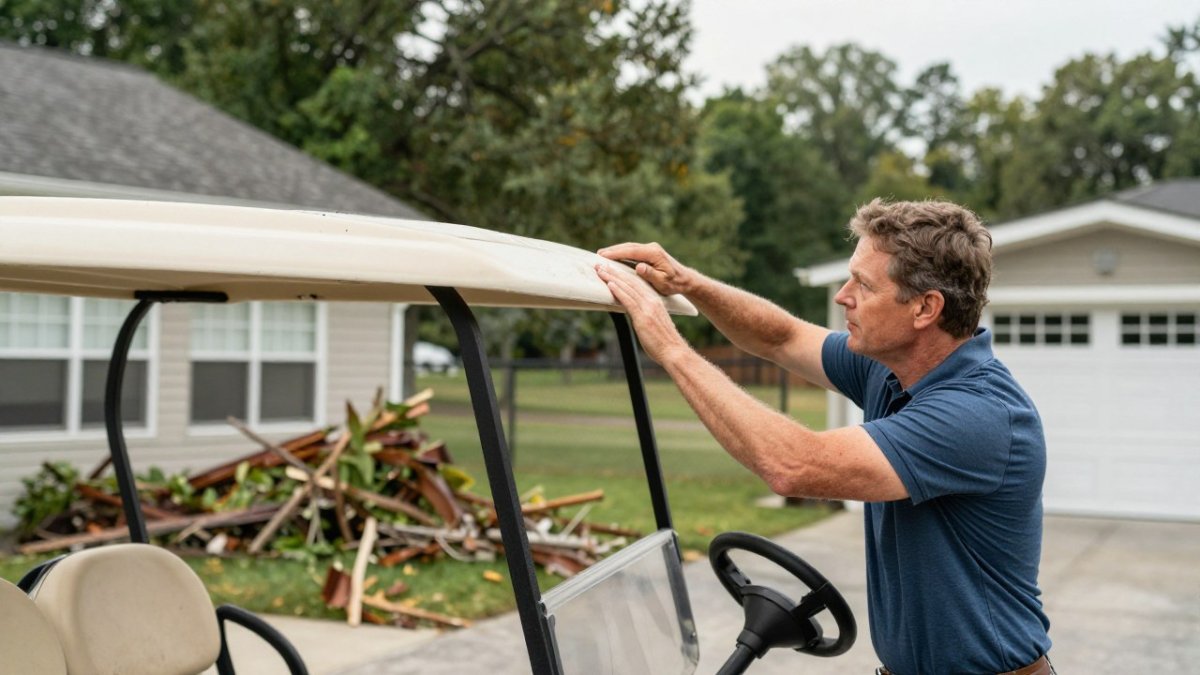
Storm damage is a common claim for carts kept outdoors.
Insurance Information Institute guide to auto insurance coverages
If your cart sits outside year-round, comprehensive coverage is worth considering. Replacing a flooded controller or a cracked canopy can cost far more than the premium difference.
Not sure whether your cart took on water? Our guide to 7 signs of flood damage in golf carts walks through what to check before you call anyone.
Golf Cart Mechanical Breakdown Coverage: What Insurance Will Not Fix
Standard golf cart insurance does not cover mechanical breakdowns, wear and tear, or routine maintenance. This is the single most common source of confusion we see, because owners hear "full coverage" and assume it works like a repair warranty. It does not.
The mechanism is straightforward once you see it: insurance transfers the risk of an accidental event, while a warranty or service plan transfers the risk of parts wearing out.
Wear and Tear, Routine Maintenance, and Aging Parts
Three exclusions catch owners off guard again and again.
- Wear and tear: brakes, tires, bushings, bearings, and batteries degrade with normal use. Insurers expect these to be replaced on a schedule, not claimed after failure.
- Routine maintenance: tune-ups, fluid changes, belt adjustments, and scheduled service are owner responsibilities. Skipping them can also give an insurer grounds to question a related claim.
- Aging parts: a 2016 controller that finally fails is not a covered loss just because the cart is insured. Depreciation and pre-existing condition language usually apply.
Owners who file a claim for a burned-out motor are sometimes surprised when the adjuster asks for service records. If the failure looks like neglect rather than an accident, expect a denial. Keep your maintenance receipts, they protect you when a genuine accident claim is questioned.
Modified, Lifted, and Customized Carts
Aftermarket parts are where coverage gets quietly limited. A lift kit, custom wheels, an upgraded motor, a lithium conversion, or a custom paint job may not be covered at full value unless you declare them.
Call your insurer and list every modification with receipts. Otherwise you may be paying for coverage you will not collect.
If you are budgeting for the bills insurance will not touch, our golf cart maintenance cost breakdown shows what to plan for.
Liability and Medical Payments: When Repairs Are Not the Whole Bill
Repairs are rarely the biggest exposure. Injury expenses and property damage claims against you can run far higher than a body panel.
Liability coverage pays for bodily injury and property damage you cause to others. Medical payments coverage handles injury bills for you and your passengers, regardless of fault.
National Highway Traffic Safety Administration guidance on low-speed vehicles
One detail to check: many policies restrict coverage to on-course or private property use. If you drive on public roads, confirm your policy actually covers that use.
How a Golf Cart Insurance Claim for Repairs Works
A golf cart insurance claim for repairs follows a predictable path: report the loss, document the damage, get an estimate, wait for the adjuster, then approve the repair. Most delays come from missing photos or an estimate the insurer questions, not from the coverage itself. The difference between a smooth claim and a frustrating one is usually preparation, not policy language.
Here is the sequence we would follow, with the detail that actually matters at each step.
- Report the loss promptly. Call your insurer and open the claim the same day. Late reporting is one of the few things that can complicate an otherwise valid claim.
- Document everything before anything moves. Photograph the damage from several angles, plus a wide shot showing the cart's location and any contributing conditions (fallen limb, wet ground, the other vehicle). Note the date, time, and what happened in writing.
- Get a written, itemized repair estimate. A line-by-line estimate, parts, labor, paint, speeds up the adjuster's review and reduces back-and-forth. Vague estimates get questioned.
- Meet the adjuster and understand their decision. The adjuster confirms the damage matches a covered event, separates old wear from new damage, and applies your deductible and any policy limits. Ask which valuation method applies: actual cash value or replacement cost.
- Get written approval before work starts. Unapproved repairs can be denied. Confirm the approved amount and what happens if the shop finds hidden damage mid-repair.
- Keep every receipt and photo. Parts and labor documentation protects your payout and supports any supplement request.
Deductible Math and Whether Filing Makes Sense
The deductible is your share before the insurer pays, and it decides whether a claim is worth filing. Say a front-end impact causes $2,000 in damage and your collision deductible is $500.
Watch out: filing a small claim to save a few hundred dollars can raise your premium at renewal. Save collision claims for damage that genuinely hurts, and ask your agent how a claim may affect your rate before you file.
Repair Versus Total Loss
Insurers compare the repair estimate to the cart's actual cash value. If repairs cost more than the cart is worth, they total it and pay the value instead. If repairs are cheaper, they pay for the fix.
Once the claim is approved, the next question is speed. Our fast golf cart repair service handles the work once you are cleared to proceed. If you are stuck waiting, this breakdown of why golf cart repairs take so long explains the usual holdups.
Repair or Replace? How Insurers Decide After a Covered Loss
Insurers compare the repair estimate to the cart's actual cash value. If repairs cost more than the cart is worth, they total it and pay the value instead.
Replacement cost coverage changes the math. With it, the insurer factors in what a comparable cart costs today rather than what you originally paid.
- Repair wins when: the estimate is well below the cart's value
- Replacement wins when: frame damage or flood damage pushes repairs past the value
- Your deductible applies either way
Ask your insurer which valuation method your policy uses before you file. It shapes the entire outcome.
Get Your Cart Inspected Before You File a Claim
An inspection before you file does two things: it separates covered damage from old wear, and it gives the adjuster a clean starting point. Hidden damage, especially frame rust or water intrusion, often decides whether a cart gets repaired or totaled.
If you're unsure whether the damage is claim-worthy, get it looked at first. Our professional golf cart diagnostics service identifies what's actually wrong so your claim reflects real damage, not guesswork.
Golf cart insurance covers repairs only when your damage matches a covered event, and the fine print decides that. Before you file, know your deductibles, your exclusions, and your cart's real condition.
Frequently Asked Questions
Does golf cart insurance cover repairs after an accident?
It can, if you carry collision coverage. Collision coverage typically pays to repair damage to your own cart after an accident with another golf cart, a street vehicle, or a fixed object, up to your coverage limit and minus your deductible. Liability coverage handles damage you cause to someone else's property or injuries to other people, not your own cart. Check your policy declarations page to confirm which coverages you actually carry before assuming a repair is covered.
Does golf cart insurance cover mechanical breakdowns?
Standard golf cart policies generally exclude mechanical breakdowns, wear and tear, and routine maintenance. A failed motor, a worn belt, or a dead battery from normal use is usually your responsibility. Some insurers offer mechanical breakdown coverage as an add-on, so ask specifically. Keep service records too: if a breakdown traces back to a covered event like a collision or flood, that changes the claim, but normal wear is almost never covered.
Will insurance pay for golf cart repairs if I hit another vehicle?
Two coverages can respond. Your collision coverage may pay to repair your cart, minus the deductible. Your property damage liability coverage may pay for the other vehicle's repairs, up to your liability limit. If the accident happened on a public road, your state's registration and insurance rules apply, so confirm your cart is legal for street use and that your policy matches how you actually drive it.
Is my golf cart covered by my homeowners insurance?
Sometimes, but usually with limits. Many homeowners policies extend to golf carts used on private property, often with a low sublimit for property damage and liability. Off-course use, public roads, and higher-speed carts typically need a standalone golf cart policy. Ask your agent two questions: what sublimit applies to the cart, and whether the policy responds away from your property. If you drive on roads or in a community, a dedicated policy is the safer answer.