 How-to
What Should You Check When Buying a Used Electric Cart?
Last Updated: October 30, 2026
Quick Summary
When buying a used electric cart, check the model year, serial number, and title first, then inspect the frame, wiring, batteries, brakes, and steering. Test the battery pack with a multimeter and budget for replacement costs before you negotiate.
- Ask for the serial number and compare it against the manufacturer's decoding chart.
- Plan on 45 to 60 minutes for the inspection and bring a flashlight, multimeter, and rag.
- A healthy 6V battery should read near 6.3V at rest; an 8V near 8.4V.
- A pack older than roughly four to five years is living on borrowed time.
- A test drive should last at least ten minutes on a mix of flat ground and a slope.
Table of Contents
- Start With the Cart's Age, Condition, and Paperwork
- Your Used Electric Golf Cart Inspection Checklist
- How to Run a Used Golf Cart Battery Test
- Review the Golf Cart Maintenance Records
- Take a Used Golf Cart Test Drive
- Budget for Repair Costs and Total Cost of Ownership
- Check Safety, Title, and Local-Use Requirements
- Book a Pre-Purchase Inspection at Amplify Your Ride
- Frequently Asked Questions
Start With the Cart's Age, Condition, and Paperwork
Knowing what to look for when buying a used electric cart starts with three facts the seller should hand over before you touch a switch: model year, serial number, and title. A used electric cart is only as trustworthy as its paper trail. Age sets expectations for battery life and parts availability, condition shows how hard those years were, and paperwork proves the cart is legally yours to buy and register.
Ask for the serial number first, then compare it against the manufacturer's decoding chart.
A common mistake is judging the cart by paint and seat covers; fresh cosmetics hide old problems.
If you are early in the process and want the full picture before you start inspecting, our used golf cart buying guide 2026 walks through the whole decision from budget to delivery.
Your Used Electric Golf Cart Inspection Checklist
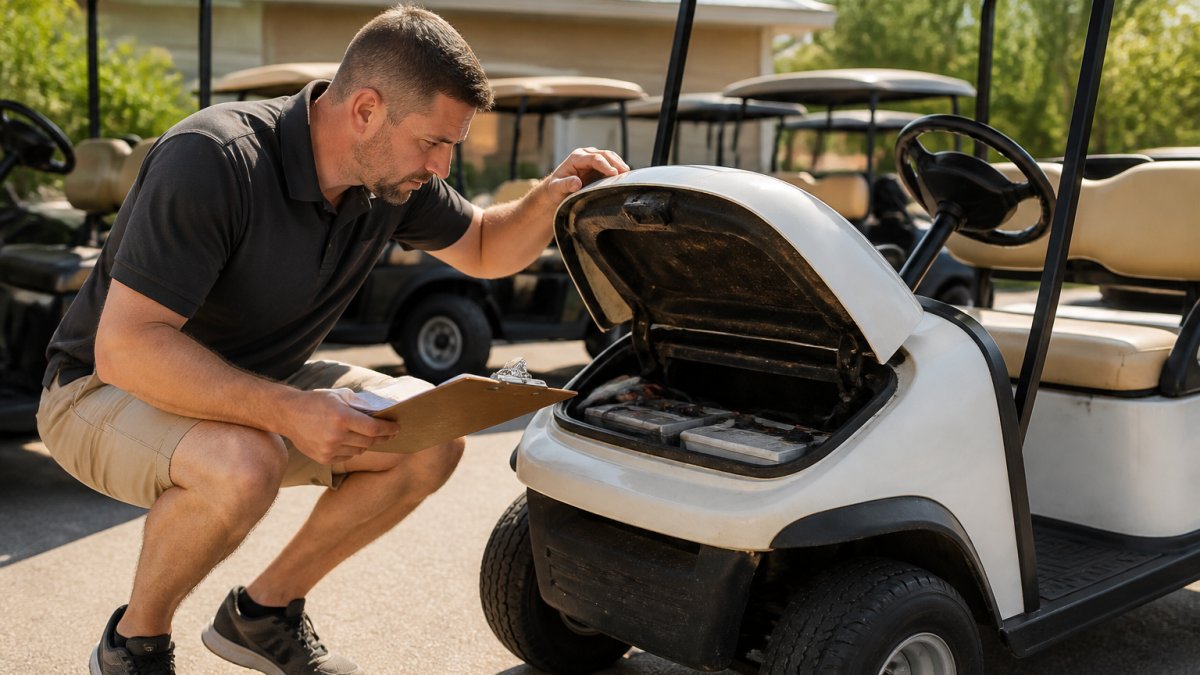
A used electric golf cart inspection checklist should cover six areas: frame and body, seats, wiring and electrical components, batteries, brakes and steering, and accessories. Work through them in that order, since structural problems end the conversation before electrical ones matter. Bring a flashlight, a multimeter, and a rag, and plan on 45 to 60 minutes.
Frame, Body, and Seats
Start underneath. Rust on a golf cart frame is structural, not cosmetic, and it is the most expensive problem to fix because it often means the cart is scrap. For a deeper guide on spotting rust during a used-cart inspection, see how to inspect used golf carts for rust.
On the body, press along the fenders and rocker panels for cracks or filler. Seat vinyl should be supple, not cracked or split at the seams, and the seat base should feel solid when you press down.
Electrical Components, Wiring, and Accessories
Wiring tells you how the cart was treated. Look for brittle insulation, electrical tape splices, and wires rubbing against the frame. Factory harnesses are bundled and clipped; a nest of loose zip-tied wires means someone has been chasing a problem.
Test every accessory: headlights, taillights, turn signals, brake lights, horn, and any USB or sound system. Flip the forward/reverse switch and listen for the reverse buzzer.
How to Run a Used Golf Cart Battery Test
A used golf cart battery test takes about 20 minutes with a multimeter and tells you more about the cart's true value than any other check.
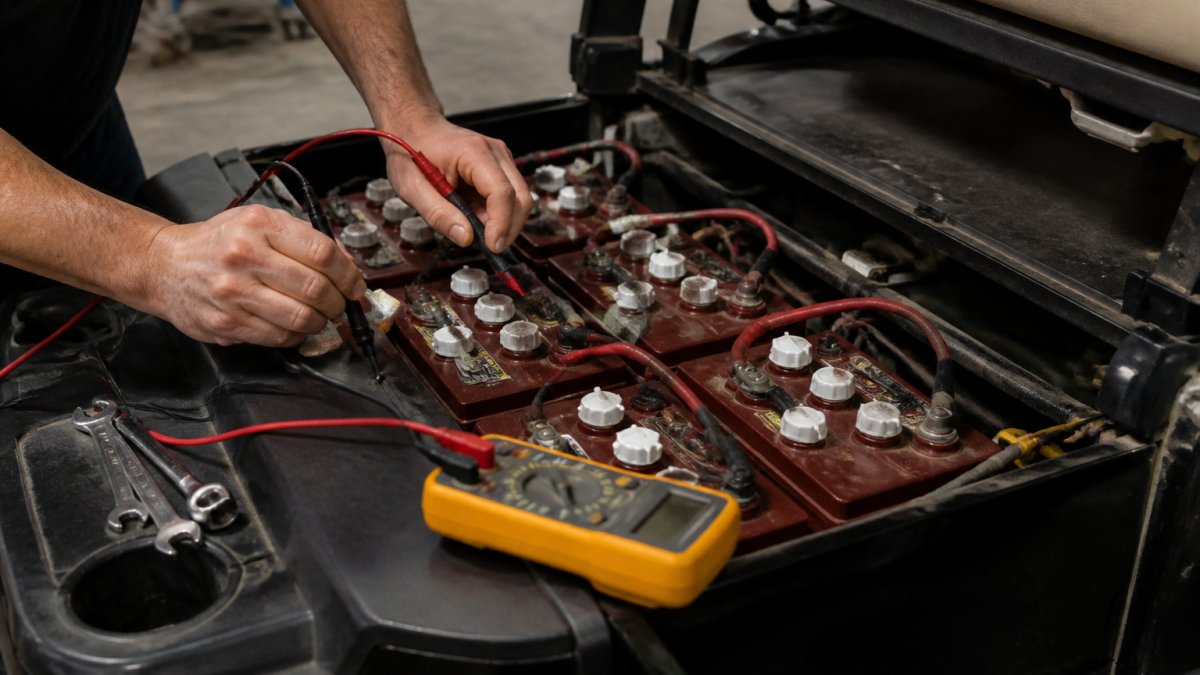
Here is the procedure we recommend:
- Charge the cart fully before you arrive, or ask the seller to. A test on a half-charged pack means nothing.
- Let the pack rest at least an hour after charging, then measure total pack voltage.
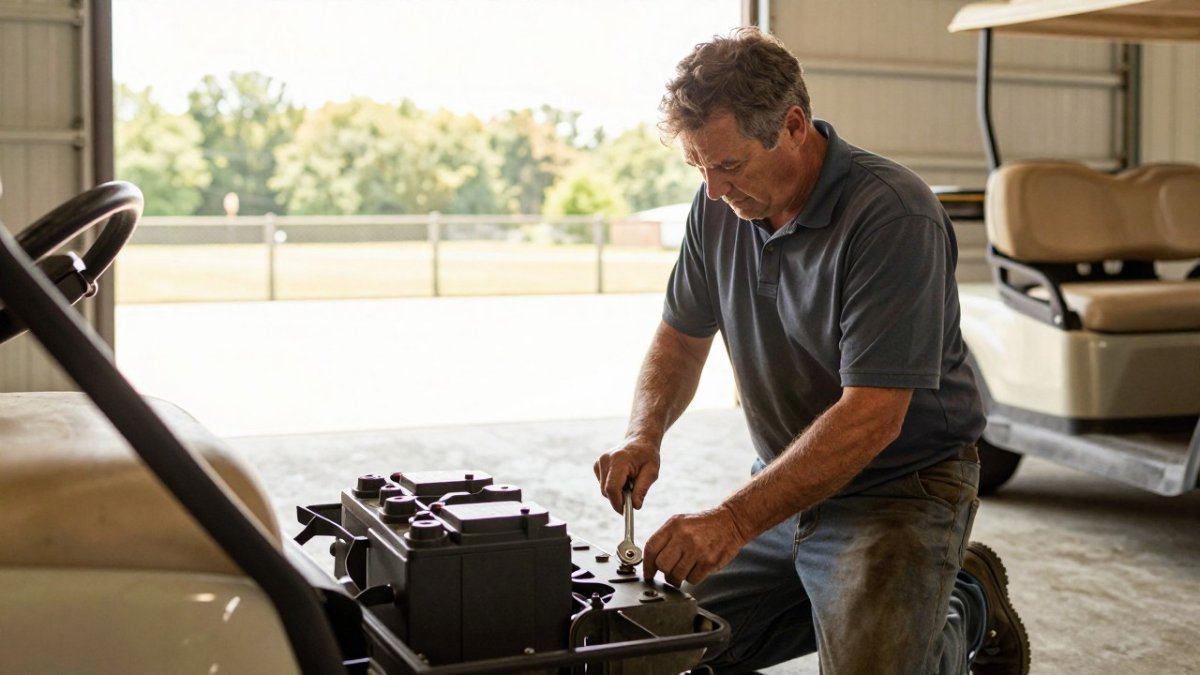
- Test each battery individually. A healthy 6V battery should read near 6.3V at rest; an 8V near 8.4V. Write every number down.
- Look for outliers. One battery noticeably lower than the rest means the pack is unbalanced and headed for replacement.
- Load test it. Turn on the lights and press the accelerator against the brake briefly, then re-measure. Voltage that drops hard under load signals a failing pack.
- Check the charger. Plug it in and confirm it engages and the ammeter moves; a dead charger is a separate expense.
Reading the Battery Installation Date and Terminals
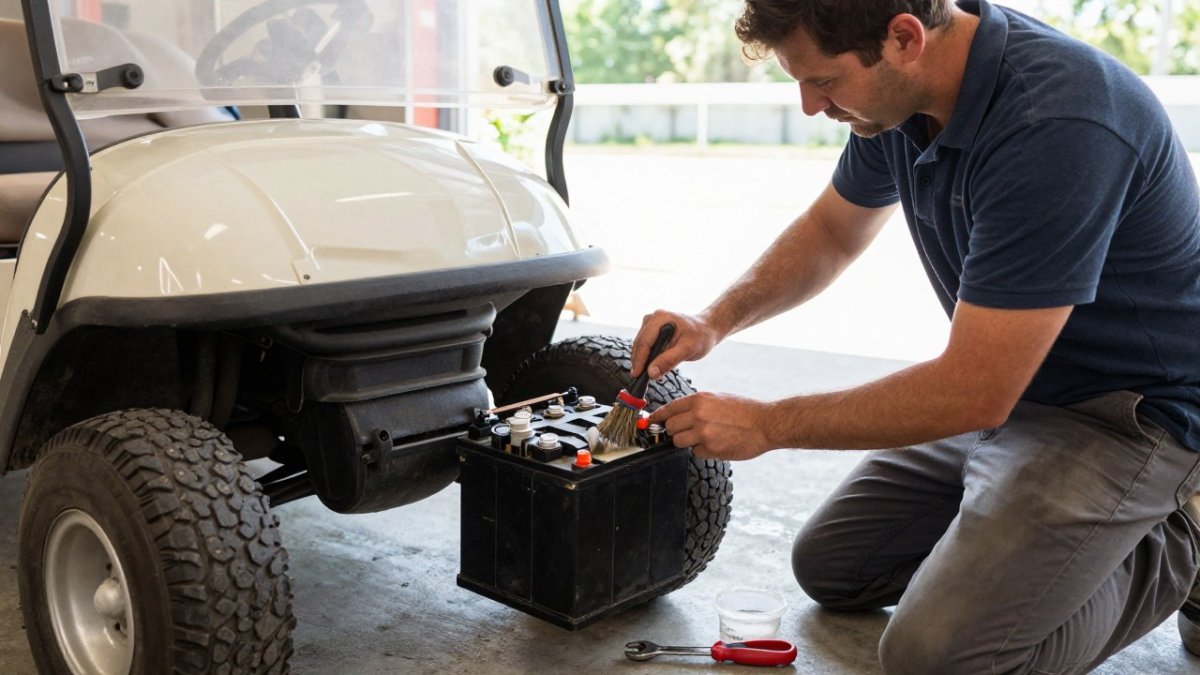
Every lead-acid battery carries a date code stamped into the case or on a sticker. Find it and write it down.
Inspect the terminals next. White or green crust is corrosion, and it spreads.
If the pack fails, know what you are walking into before you sign. Our golf cart battery replacement cost breakdown shows what a new pack will cost.
Review the Golf Cart Maintenance Records
Golf cart maintenance records are the closest thing to a service history, and a seller who keeps them usually took care of the cart.
What matters is the pattern, not the stack of paper. Regular annual service suggests a cared-for cart.
No records at all is not an automatic dealbreaker, but it should lower your offer: you are buying uncertainty, so price it in.
Take a Used Golf Cart Test Drive
A used golf cart test drive should last at least ten minutes on a mix of flat ground and a slope, after the cart is fully warmed up. This is where hesitation, wobbles, and brake problems show themselves.
Drive it the way you will actually use it. Accelerate smoothly, then hard. Coast, then brake firmly. Turn at low speed in both directions. Listen for grinding, whining, or clicking from the rear end.
Brakes, Steering, Tires, and Suspension
Brakes should stop the cart straight with a firm pedal and no grinding. On carts with regenerative braking, confirm the cart slows when you lift off the accelerator.
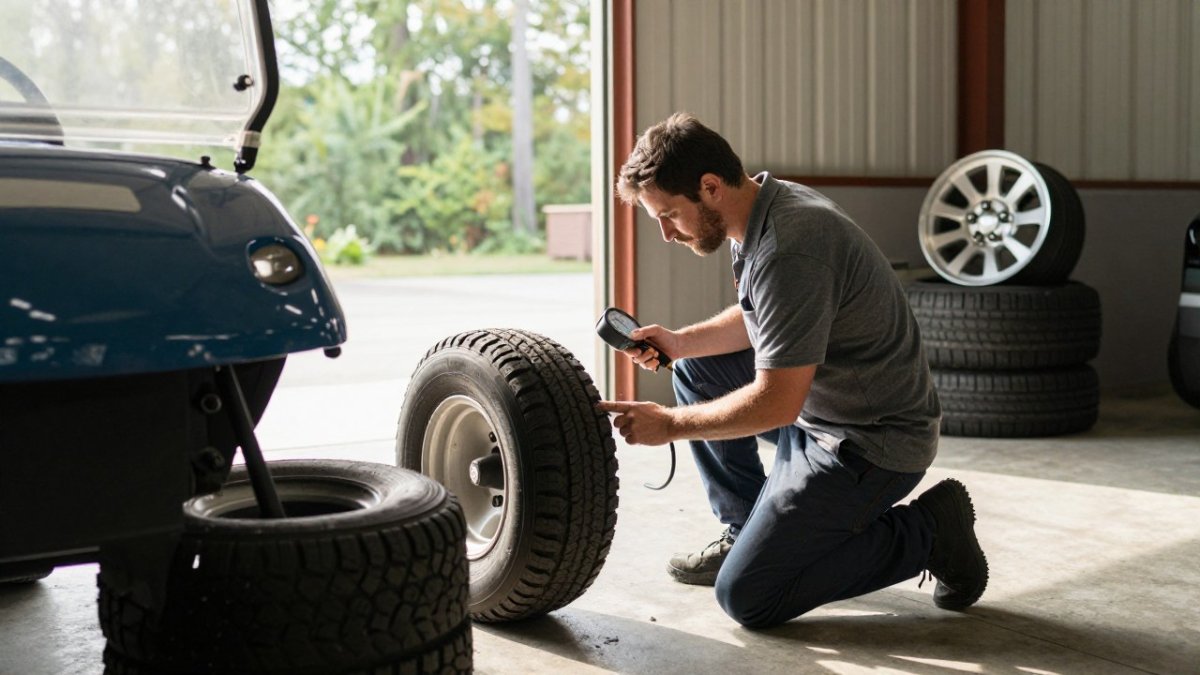
Steering should feel tight with no play at the wheel. Tires should wear evenly; uneven wear points to alignment or suspension trouble. Bounce each corner and listen for clunks. Check the leaf springs for cracks and the shocks for leaks.
Budget for Repair Costs and Total Cost of Ownership
Total cost of ownership on a used electric cart runs well beyond the sticker price. Batteries, tires, brakes, charger health, and routine service decide what the cart actually costs you over the first three years. Convert every inspection finding into a dollar line before you negotiate, so the offer reflects the cart you are really buying. For a full breakdown of ongoing expenses, see golf cart maintenance costs.
Build a three-year cost worksheet
Use a simple worksheet with four columns: item, when it hits, estimated cost, and whether the inspection already flagged it. Fill it in during the walkthrough, not after.
| Cost line | When it hits | What drives the number | Inspection trigger |
|---|---|---|---|
| Battery pack replacement | Immediate to 24 months | Pack voltage, age code, chemistry, and whether any battery is an outlier | Any battery below rest voltage for its class, bulging cases, or a date code older than about four to five years |
| Charger replacement or repair | Immediate to 12 months | Whether the charger engages, the ammeter moves, and the plug and cord are intact | Charger does not engage, ammeter stays flat, or cord insulation is cracked |
| Tires | 0 to 24 months | Tread depth, evenness of wear, and sidewall cracking | Uneven wear, cracks, or tread near the wear bars |
| Brakes | 0 to 24 months | Pad or shoe life, drum or rotor condition, cable adjustment | Grinding, a soft pedal, or a cart that pulls to one side |
| Steering and suspension | 0 to 36 months | Play at the wheel, leaf spring cracks, shock leaks | Clunks over bumps, wandering, or visible leaks |
| Controller or motor repair | 0 to 36 months | Whether the cart hesitates, smells hot, or throws a fault | Hesitation under load, burning smell, or a fault code |
| Routine service | Annual | Oil-free electric drivetrain still needs brake, tire, and connection service | No records, or records that stop more than a year ago |
Turn inspection findings into an offer
Price the cart as if the batteries will fail tomorrow. If the pack is five years old, treat replacement as a near-term cost and negotiate accordingly.
A workable rule is to subtract the flagged immediate costs from the asking price, then subtract a reserve for the items you could not verify. If the seller will not move on a cart with a failing pack, compare it honestly against a cart with a newer pack, not against the sticker price.
Check Safety, Title, and Local-Use Requirements
Safety and legal checks decide whether the cart is usable where you plan to drive it, and they are the two areas buyers most often skip because the cart looks fine. Treat them as a separate pass after the mechanical inspection, with a checklist you actually mark off.
Roadworthiness checklist
Run this list with the cart on level ground, then repeat the brake and steering items during the test drive.
- Brakes: the cart stops straight with a firm pedal, no grinding, and no pull to one side. On carts with regenerative braking, confirm the cart slows when you lift off the accelerator.
- Steering: tight with no play at the wheel, and no wandering at speed.
- Tires: even wear, no sidewall cracks, and tread above the wear bars.
If any brake, steering, or tire item fails, get a professional inspection before you commit. Those systems decide whether the cart is safe to operate, and they are the cheapest problems to fix before a failure rather than after.
Title, serial number, and proof of ownership
Ask for a clean title or certificate of origin, and verify the serial number on the cart matches the paperwork. Walk the frame and look for a stamped or riveted plate; a missing or altered serial number is a stop sign, not a negotiating point. A bill of sale alone is weaker evidence than a title, and a seller who cannot produce either is asking you to take on ownership risk you cannot cure later.
Local-use rules
Local-use rules vary by state and municipality, so check before you buy. Some areas allow carts on certain public roads with a permit and equipment requirements; others do not. Learn how to drive a golf cart on public roads legally. The questions to ask your local authority are straightforward: is the cart classified as a golf cart or a low-speed vehicle, what equipment is required, is registration or insurance needed, and which roads are permitted.
Book a Pre-Purchase Inspection at Amplify Your Ride
A pre-purchase inspection is the cheapest insurance you can buy on a used electric cart. A trained technician can test the battery pack under load, check the frame for rust, and verify the electrical system in less time than it takes to negotiate a bad deal.
Amplify Your Ride sells new and used golf carts and offers service and parts, so a pre-purchase inspection can be discussed directly with the dealership.
Visit Amplify Your Ride for current used inventory and to ask about a pre-purchase inspection.
Frequently Asked Questions
How can you tell if a used golf cart battery is still good?
Check the battery installation date first, then test each battery under load with a multimeter. A healthy 6V or 8V battery should hold close to its rated voltage after a full charge and not drop sharply when the cart is driven. Look for swollen cases, corrosion on the terminals, and uneven readings across the pack. If the batteries are more than four to five years old, plan for replacement in your budget even if they still work.
What should you check during a used golf cart test drive?
Drive the cart on a flat surface and a slight incline. Listen for hesitation, grinding, or whining from the motor and rear end. Test the brakes for firm, even stopping, check that steering tracks straight, and feel for wobble or vibration that could point to worn tires or suspension. Run through lights, signals, horn, and any accessories. A used golf cart test drive should last at least five to ten minutes so the motor and controller reach normal temperature.
Is it better to buy a used electric cart from a dealer or a private seller?
A private seller may offer a lower price but often has no records and no recourse if something fails the week after purchase. If you buy privately, insist on a used electric golf cart inspection checklist and a battery test before money changes hands, or pay a shop to inspect it for you.
What maintenance records should you ask for when buying a used golf cart?
Ask for battery installation dates, charger service history, brake and tire replacements, and any motor or controller repairs. Records showing regular watering and terminal cleaning on flooded lead-acid packs are a good sign. If the seller has no golf cart maintenance records, treat the cart as higher risk and factor a full service into your offer.